Blog #3 Plan B to Newfoundland
- Pamela Sonier
- Jun 25, 2024
- 11 min read

Updated: Jul 13, 2024
Interesting fact about us: both Guy and I are pretty good with directions. During this trip we have been doing really good with the exception of a few wrong turns here and there. Lefts and rights,clockwise and counter clockwise, have always been a struggle with me - maybe because I am left-handed. So, Guy came up with a good idea and has taped a “left” and a “right” words on my side of the dashboard. No mistakes or misunderstandings since then. Guy though, still has his doubts once in a while and that’s okay. Traffic circles known also as “Roundabouts” are also an issue that’s gotten resolved. We have encountered quite a lot of these on this trip. I would always go into great detail with my hands to explain to Guy at which turn he needs to exit (not the best idea when he is driving). Now, our clever way of dealing with this is I just say exit number 1, 2, 3, or 4 turnoff, it’s working well. Especially since Guy is not at all fond of roundabouts…

Left or Right ??
As it turned out, a nice part of our plan B (long ferry to Newfoundland versus the Labrador highway), is that after driving out of Gaspe into New-Brunswick, was spending another overnight stop in Moncton NB to stay with family again. We enjoyed more home cooked meals, hot showers, chitchats, cold beer, a comfortable night in a soft bed, and an air conditioned home during the heatwave (34 degrees). As we write this, there is a heat wave raging through Ontario, Quebec and the Maritimes. Adding on the humidex (a word pretty much unheard of in Alberta), the temperature feels more like 44 degrees Celsius. We are struggling with this but Treme is having a harder time, panting away. One would think a dog who comes from Qatar in the Middle East would be adjusted to this, but her, oh no….
The following morning, as we made our way towards North Sydney Nova Scotia to catch the ferry to Newfoundland in a few days, we stopped in for a quick visit and a cold beer with friends Shona and Neal just outside of Amherst Nova Scotia. They have a very comfortable family summer cottage on the edge of the Northumberland Strait. They have created their own little piece of paradise there. They told us an interesting bit about the Anna Swan Museum in Tatamagouche NS not far from where they are, worth repeating here. Anna (Haining) Swan was one of the tallest woman in the world. She stood 7 feet 11inches, weighed 400 lbs and was known as the “Nova Scotia Giantess”. She was born in 1846 and died in 1888. She led an interesting and successful life. She worked with P.T. Barnum Circus, travelled the world, was educated, got married and had 2 children (unfortunately neither survived). This kind of stuff is right up our alley, interesting with a bit of quirkiness to it. Unfortunately the museum is only open on Saturday and since we were there on Wednesday, we were unable to visit. We will have to come back another time, maybe.

Neal & Shona’s Little Paradise

Anna Swan with her parents
The following night we stayed in a Harvest Host location in Scotsburn Nova Scotia. We suffered the night without Air Conditioning, no electrical plugin. We do have an air conditioner in our Roadtrek but we need to be connected to a 30 amp outlet to run it. The other option would be to keep the engine running overnight - that’s not going to happen. The next day we decided to be kind to ourselves and found a nice campsite with 30 amp electricity hookups, running water, hot showers. So if need be we can sleep with the air conditioning running.
Lupines, lupines, lupines standing tall, colourful, and majestic everywhere. Driving in New Brunswick, Quebec, Nova Scotia, and Newfoundland, we can’t help but admire all the lupines that grace the roadside. Beautiful patches of pinks, yellow, purples blossoms. We think the national flower for the Maritime provinces should definitely be the lupine. They are literally everywhere and beautiful.

Lupines side of the road

And more Lupines!
On the way towards our campsite in Mira River Provincial Park we passed through many little towns and enjoyed the scenic views. We stopped in the picturesque village of Baddeck NS a popular tourist town. This is where the Alexander Graham Bell Museum is located. We walked along the grounds but did not go inside the museum. The temperature was 32 degrees Celsius without the humidex and we would not leave Treme in the Roadtrek - it would not be safe.
Who knew we would discover an interesting monastery on our way to North Sydney, well we did! Our Lady of Grace Monastery located in Monastery NS has an amazing story and an elaborate history. Dating back to 1825 when it was first established by Trappist Monk, Father Vincent de Paul Uacques Merle who served the Acadians and the Mi’kmaq in the area. In 1857 a number of monks arrived from Belgium which helped sustain the monastery. In 1892 the entire monastery burnt to the ground and was rebuilt in 1894. In 1902 the Timadeuc community purchased the monastery to create a refuge but in 1919 they returned to France and the monastery stayed vacant until 1938 when a group of German Augustinians purchased it, restored it, and renamed it “St Augustine’s”. Hilter was strong in Germany at this time and this is where they sought refuge. They established a farm in service of the community, opened a retreat house, built a chapel and added a recovery house. In 1952 they opened Our Lady of Grace Shrine and the Holy Spring. Here one can walk the Way of the Cross, pray, meditate, or simply enjoy the peacefulness. This is also where the Holy Spring is which is believed to have been discovered by the Belgian monks. Due to declining numbers the Augustinian Fathers left the monastery in 1999, a group of Maronite monks arrived at the monastery in 2000 and are the ones that gave the monastery its current name, these monks left in 2007. The Contemplative Augustinian Nuns moved in near the end of 2007 but were recalled to Rome in 2022 due to the nuns ageing and illnesses. Wow, and there’s more! Recently, in January 2023 a new Our Lady of Grace Monastery Foundation was set up to govern operations. Anyone can visit the monastery and they offer daily and weekend mass. We came there and saw no one. We walked inside the buildings, took a few pictures, and still saw no one. No one to be seen at the Our Lady of Grace shrine neither, only mosquitoes and horse flies.

The Monastery

The Complex

Entry to the Shrine

Pathway to the Shrine

Holy Spring

The Shrine
The Blue Puttees ferry in all her glory, please offer us a safe and calm journey this night as we travel to Newfoundland. The crossing was uneventful, other than having very uncomfortable reserved seating. We arrived in Port aux Basques at 4:30 am, at least one hour ahead of scheduled time. Even though we did not get much sleep that night, we decided to travel to Rose Blanche anyway, about one hour drive. We managed to get there and decided to stop at a roadside pullout to catch a few hours of sleep. After 2 hours of sleep, we arrived at The Rose Blanche Lighthouse: built in 1871 and began operating in 1873. The Rose Blanche is the last granite lighthouse on the Canadian Atlantic Seaboard. We were greeted with friendly staff and lively fiddle music playing - pre recorded and quite entertaining. The lighthouse location is very picturesque with a trail along the white rocks and cliffside leading up to it. We entered the lighthouse and the inside is set up to show what the life style would have been like at the time.

The Blue Puttees

Entering the mouth of the ferry

Goodbye Sydney Nova Scotia

Full moon on the ferry

Early morning arrival to Newfoundland

Rose Blanche Lighthouse

Rose Blanche Lighthouse

Stairwell to the light
As we left Rose Blanche we travelled on the very scenic Route 470 also known as the Granite Coast drive. We now understand why Newfoundland is called the rock. Small villages have houses constructed on top of rocks. There are small lakes and ponds formed by holes and crevasses between rocky hills everywhere. The roads and streets twists and turn around rocky landscape - makes for interesting driving. Guy started counting potholes in the roads but gave up after 9 as he was running out of fingers and needed to hold the steering wheel…. Potholes definitely make the driving interesting on this part of the trip. We had planned a few stops along the way in Burnt Islands, and Isle aux Morts (Island of the Dead) named so because of the huge amount of shipwrecks in the area. We wanted to visit the Walters House (over 100 years old) but it was closed. We also wanted to hike the Harvey Trail (dedicated to the Harvey family who helped save 163 people from the shipwreck “Despatch” and then again 10 years later saved 25 people from the sinking “Rankin” with the help of their Newfoundland Dog “Hairyman”. Well, the trail was closed due to washouts and the Hairyman’s Safe Haven Cafe & Craft Shop (Traditional Newfoundland food and crafts as well as “It’s a Dogs Life” exhibit featuring many Newfoundland Dog hero stories including Hairyman the Harvey family’s dog) was closed even though the website said it was open. A bit of a disappointing start so we decided to camp for the night at the Barachois Pond Provincial Park outside Stephenville, get some well deserved sleep and start fresh the next day.

Lily Pond on the Rocks

View along Route 470

Roadside view
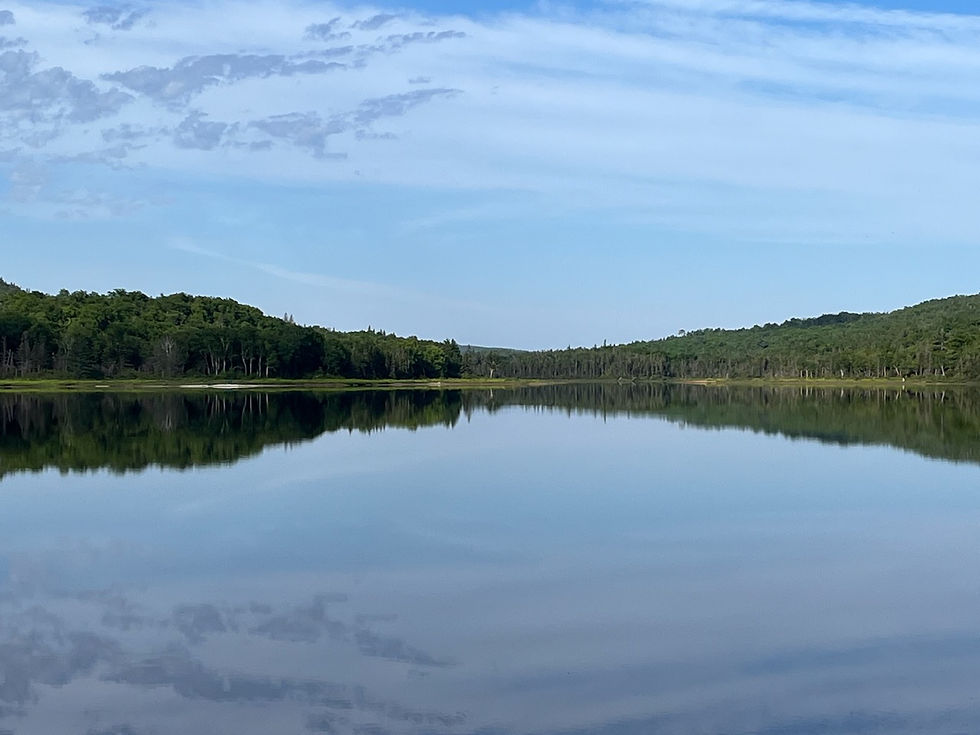
View from our campsite at Barachois Pond Provincial Park
The next leg of the trip was the French Ancestry Route. This is a 161km pothole riddled route around the Port au Port Peninsula. Speed limit for this whole drive is 60 km/h, which made for a more engaging drive. We passed through many small unique villages and the cliffside scenery is quite spectacular. Our first stop was Boutte du Cap. There is a traditional French bread oven here with daily demonstrations and bread tasting, starting July 1st. I am beginning to think this might be a blog of all the things we came to see and do and were unable to, due to nature or not opened yet?? We hiked the Bread Crumb Trail along the top of the cliffs where we can faintly see Quebec at a distance across the water. Also, the only Acadian Monument in Newfoundland is here. The plaque explains some of the “Great Acadian Deportation of 1755”. We had lunch here on the edge of a 50 foot cliff. The sun was shining and a nice breeze blowing kept the mosquitoes away. We enjoyed the views and the crashing waves so much we decided to stay and camp the night. That evening though, the wind became stronger and the rain started pouring down. As the van was parked with its side facing to the wind, every wind gust shook and rocked the van. This made for a very uncomfortable situation including the torrential downpour. We decided to move from our wonderful spot overlooking the cliffs a few hundred feet down the road to a more protected area. This turned out to be a wise decision, we slept peacefully. We had learned our lesson from a previous night in the Gaspe Penisula where we experienced a stormy night that rocked the Roadtrek all night and left us with very little sleep. And I must say, two slightly grumpy people travelling the next day in a little tin box, not pleasant.

The French Bread Oven

Notice the Bread Slices walking

See the small toilet rolls in the corners

The Acadian Monument

Cliffside views Boutte du Cap

Cliff side view

Camp spot for the night

Camp spot for the night

View from the Roadtrek

View from the RoadtrekWatching for whales
Woke up the next morning to rain and the mist of fog as we made our way around to complete the French Ancestor Route. First stop today Mainland NL, we glimpsed the Our Sisters Dream School - built in 1910 by French fishermen through the windows (as it was closed). We were able to see a classroom set up with wooden desks and chairs. We wandered the grounds and read the history of the area and Red Island which was originally named Isla da San Jorge by the Basques. Later the French named it L’IIe Rouge (Red Island) for its red-coloured cliffs. Red Island was one of the areas where the French Fishermen established small seasonal fishing communities from the late 1600s to the early 1700s. It never did grow into an established settlement and by 1884 there were no more than 10 residents there. It remained a French fishing station until 1904. To the residents of Red Island the land to the east was referred to as The Mainland hence the name of the village. In 1840 the first resident arrived here at Mainland NL from France. Many of the new residents came from Brittany in France and men who deserted from the French Navy hoping to find a better life in Newfoundland. The colonist found wives in the nearby Mi’kmag and Acadian communities of the Bay of St. George region.

Red Island

Sister’s Dream School Musuem

Peek inside the school through rainy windows

First spotting of a Newfoundland Dog on the beach overlooking Red Island
Further down the road, still raining, we visited Our Lady of the Lourdes Grotto in Lourdes NL which was built by a local stonemason Michael Flavin in 1987. He was supposedly inspired by the famous site in Lourdes France. He carved a grotto into a rock near the church. There is also The Way of the Cross walk up to the grotto and a beautiful blue and white rosary laying on the rock made from fishing buoys. There is also a memory walk around the area which has plaques of many of the deceased parish members. The whole experience is very calming. A lady from the church came out in the rain to greet us and to explain some things about the Grotto. Very friendly and kind.

Entry to the Grotto

The Grotto

Rosary made from buoys laid among the rocks

The Memory Walk
Just outside Piccadilly is The Faults and Folds of West Beach (Folded Rocks). It turned out to be a bit of a challenge to get to but worth the hike. We parked by an abandoned house along the road and reluctantly walked down a steep embankment onto a sandy beach. The walk along the beach was about 5 minutes and just around a corner, there they were. Really quite an amazing thing to see the way the rocks curve onto themselves along the cliffside into the sand into the water. One can only imagine the force it would take to push rocks and make them roll onto themselves…. Going back, we found a wooden ladder that got us partial way back up the embankment to an overgrown trail - a much easier climb.

Beach walk to the Folded Rocks

Folded Rocks

Folded rocks

Folded rocks

More folded rocks

Climbing the Ladder up the embankment
I had read about Our Lady of Mercy Heritage Church in Port au Port West and was eager to visit. It is the largest wooden structure in Newfoundland at 115 feet. It has a seating capacity of 1000. This church was built over a 100 years ago, between 1914-1925 mostly by volunteers using donated supplies. I find this quite intriguing how the community banded together to create the church. The marble statue of St. Theresa was imported from Italy. Right now the church is undergoing much needed renovations. It was still a beautiful building to visit.

Our Lady of Mercy Heritage Church

Marble statue of St. Theresa
Sheaves Cove is a hidden gem of beauty, serenity, and more awe inspiring moments. Tucked in the distance, is Hidden Falls which is an easy 1km hike to get to it. It crashes to the ground below and its water flows directly into the sea. Along the beach we stopped to see and hear the rocks as they roll back and forth with the waves action against the beach, an awesome sight. The sound the rocks make rolling against each other is musical and awe inspiring - words cannot describe. We walked out to the water amongst jutting rocks and stood atop to see more magnificent views. This place is surreal with beauty everywhere we turned.

Hidden Falls

Guy smiling

Pamela the Gazelle

Superman!

Rocks rolling back and forth with the waves

Lobster trap
This portion of our trip was not planned (plan B), but we managed to entertain ourselves brilliantly with the few days we’ve been here. Newfoundland you are just as vibrant, rugged, and colourful as we imagined. We are now preparing for our journey to the East Coast of Labrador and Battle Harbour. We will be back Newfoundland in about one week to continue our journey with you.


This is amazing. Never realized there was so much history or beauty to see there. And never realized you were such a writer. Even I am learning on your trip! Lol