Blog #20 - Cacti, Donkeys, Camels, Gunslingers & the Wild Wild West….
- Pamela Sonier
- Feb 15
- 49 min read

Ahh!! So here we are again, boondocking in the vast aridity of desert - not a tree in sight, only prickly cacti and rough-looking bushes. We sit outside watching the sun set in a quietness and stillness that feels almost surreal. The sky is completely clear now, and the stars will be visiting us tonight. We are in the Sonoran Desert in Arizona, spending the night by the Painted Rock Petroglyph Site.





It was definitely a rollercoaster of a highway to get to this site, but well worth all the humps and bumps and the oohs and ahhs. The Painted Rock Petroglyph Site is an archaeological site. It is a mount of rocks containing hundreds of figures and designs carved into the rocks. The designs were created centuries ago by indigenous peoples, and this site is considered important and sacred to many of the Native American tribes in southern Arizona today. The mount is surrounded by a low metal fence to prevent people from climbing or damaging the designs. We were able to walk around the whole site and look and admire these amazing petroglyphic arts. It is said that “history has walked and spoken here for many, many years”. We definitely could sense that. These designs are now somewhat of a time capsule. We guessed that since this rocky mount could be seen from a distance, it was perhaps a place where travellers, or locals, could leave messages for others who would be travelling through this harsh and unforgiving environment; perhaps messages about the direction of water or wildlife ahead; or perhaps simply messages about who has come and gone through here. A few of the messages were dated, one as early as 1821 and another with initials dated 1879.


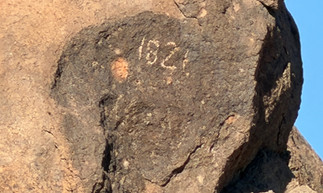


The Painted Rock Petroglyph Site
The Sonoran Desert is also famous for the saguaro cactus. Saguaros are very slow-growing, a 10-year-old plant might only be 1.5 inches tall and can live between 150 to 200 years, it is believed some are as old as 300 years. When the saguaros mature they are approximately 40 to 50 feet tall and can weigh over 6 tons when fully hydrated. The vertical "folds" expand like an accordion to store rainwater. Their branches (arms) usually don't appear until they are 50 to 100 years old. The internal part of the plant has a circular frame of woody ribs that supports it. The Saguaro often starts its growth, for the first few years, surrounded by other plants for protection. Once it grows taller and becomes stronger, it takes over the growing area and the other plants die. These are extraordinary plants living in such an unforgiving and hostile habitat, and the opportunity for us to see so many up close was a real treat.


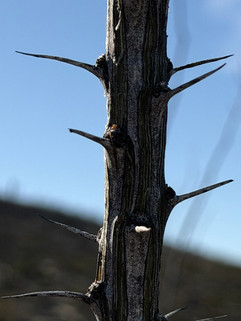


Cacti up close - just don’t touch! And definitely no hugging!
We, ourselves, find the desert environment very harsh and, to a point, repetitious and monochromatic in colour. We have found it very difficult to take clear colourful photos - all colours seem to blend together with little contrast. Yet, in its own way, the desert is very beautiful. It is severe and arid with no water in sight anywhere at this time of year. Yet there are numerous signs of past flash floods happening here - the ground is scarred by occurrences of rushing water with rivulet markings. In this desert, sudden flash floods happen during monsoon seasons usually between July to September. There are many road signs that say “do not enter when flooding”. Interestingly, there are no culverts under the roads to allow water to flow through, rather the roads are built with dips in lower areas so the water can actually run across and over the roads - interesting indeed. Visible lifeforms are rare. We’ve seen very few animals, mainly lizards, rabbits, and birds. So it seems, most animals stay hidden underground from either the extreme heat of the day or the sudden cold when the sun goes down. The desert ground is literally covered with small burrowed holes. Who knows what kind of creatures live down in these holes - hopefully we will never find out. In the desert, when it’s cold it’s very cold and when it’s hot it is very hot, there seems to be no middle ground.


Harshness of the desert
While travelling we always feel the need to visit 9/11 memorials when we find them. It is our way of paying our respects to a devastating day in our history. To both of us, it is a personal moment of our lives like no others. The 9/11 Memorial Park in Gila Bend is quaint: it sits in a small park just off one of the main streets. On site there is a small reflection pool, flags, benches, and a steel beam with attached pieces of concrete and wood from the Twin Towers. The beam weighs 4,000 pounds and is 11'8" tall. Gila Bend is one of a few Arizona cities that was granted a metal beam section from the New York Twin Towers Ground Zero site following the 9/11 attack. Every year Gila Bend holds a 9/11 ceremony here to honour those who's lives were cut short by the attacks, as well as the men and women emergency responders, and any of those who's lives were affected by the tragedy.


Gila Bend 911 Memorial Park
On our way to the Organ Pipe Monument we drove through the town of “Why” Arizona so of course we had to stop and check it out and take a few photos - why not?


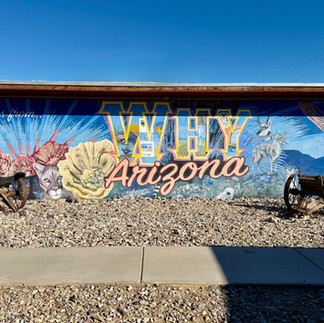


Why Arizona
Interestingly, here in the USA, some of the natural reserved spaces are called National Parks and some are called National Monuments, very different from what we are use to in Canada. So after a bit of digging we discovered why. Basically the differences between these two are designation, authority, and purpose. Congress creates National Parks to protect larges scenic and diverse natural areas. Whereas National Monuments are usually created by the President to protect specific, often smaller-scale landmarks of historical, archaeological, or scientific significance.
We traveled to The Organ Pipe Cactus “National Monument” to camp for a few days. There are over 28 species of cacti here with the most prominent being its namesake the Organ Pipe Cactus. Organ Pipe cacti is rarely found in the United States and mostly found in Mexico. But this National Monument does share 31 miles of international border with Mexico so we assume this is why there are so many here. The cactus has several narrow, olive-green stems that rise vertically from a single short trunk near the ground. These cacti can reach between 15 to 25 feet tall and can spread over 12 feet wide. Each stem has between 12 to 19 ribs lined with dark brown to black spines that turn gray as the plant matures. From April to June, funnel-shaped creamy-white flowers with a purple or pink hue bloom. These flowers are nocturnal, opening at night and closing by mid-morning. Opening at night accommodates desert pollinators like bats to spread pollen between cacti. Other cacti here are the Saguaro, The Fish Hook, the Cholla “Teddy Bear”, Prickly Pear just to name a few. From our campsite, we did hike a few of the trails. We felt we were walking into a forest of cacti of all shapes and sizes - absolutely no tree hugging here! We find cacti to be foreign and exotic and we never seem to tire of them. Each seem to stand strong and proud, no matter the size or shape.





Hiking Organ Pipe National Monument
Our campground was lovely with those beautiful Arizona desert night skies we are becoming accustomed to. There were a few signs warning us to be diligent about feral dogs, illegal immigrants, and drug trafficking activity - we guessed since we were only about 7 miles from the Mexico border. As well, there are quite a few packrats (wood rats) here. The recurring theme everyone kept telling us was “keep your hood up”. Supposedly, the rats like dark warm safe spots where they can chew on whatever they find, including electrical wires and hoses. Leaving the car hood open will deter them, apparently? Walking around the campground everyone seems to have their hood up - a bit different but maybe a good lesson learned for the future. Thank goodness that when we left here we did not have any packrat hitchhikers with us! At least none that we have found yet - we’re still listening for crunching sounds!



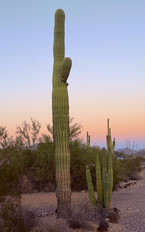

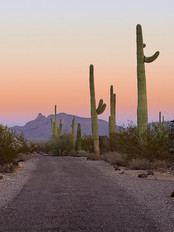


Organ Pipe Monument campground desert skies
While at the campground, just across the highway, we took advantage of the beautiful Ajo Mountain Scenic Drive. This 35 kms gravel road winds its way around the Ajo Mountain Range. It is a very small narrow dirt road which is luckily a one-way direction so there was no worries of having to move to the side for oncoming traffic. The views of the mountains and valleys were spectacular with an abundance of Organ Pipe and Saguaro Cacti. While some of the saguaros cacti had no arms yet, others had numerous arms waving, reaching, interlocking, and some with almost humanistic features. Some seem to be running, dancing, and playing with each other. Some even had their arms interlocked in such a way as they seem to be praying. I just wanted to stop and paint expressive faces on them. At a popular stop along the way we spotted a sweet little chipmunk in the rocks, first sign of animal life in awhile. Other than hearing a few coyotes in the distance, we have seen and heard many Gila Woodpecker, Cactus Wren, and other birds but not much else. I guess we needed to look under car hoods, or else dig holes in the ground which is not likely going to happen.


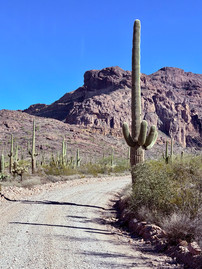


Ajo Mountian Scenic Drive
We took the road less traveled to Patagonia Arizona. Along the way, we were very lucky and saw a wild donkey on the side of the road. What a majestic animal. We stopped, admired its beauty, and took pictures until he ran into the bushes - he/she was very shy. Along the way there were lots of beautiful mountainous sceneries.


The Patagonia area is famous for birds and bird viewers. We stayed the night at the Patagonia Lake State Park which we swear has the only body of water in all of Arizona, hence all the birds and birders (bird watchers). Birders were everywhere all equipped with special outfits, giant binoculars, walking sticks. and cameras. We, for our part, took advantage of a hot shower and a quiet night here. The next morning, a short distance from the park we visited the The Paton Center for Hummingbirds which from March to June hosts huge amounts of migrant hummingbirds and other birds as well. From September to October/November there is a second wave of migration. We visited here in January so there was not a lot of activity but we did catch a glimpse of the beautiful Violet-Crowned Hummingbird. On site we were provided complimentary binoculars and being able to see the Violet Crowned Hummingbird up close was beautiful. From a distant its head looks black but through the binoculars we could see the vibrant violet. We also saw the Anna’s Hummingbird which is one of the most common species and it can be found in the area year round. It was impossible to get any good photos of the hummingbirds as they were just too fast.


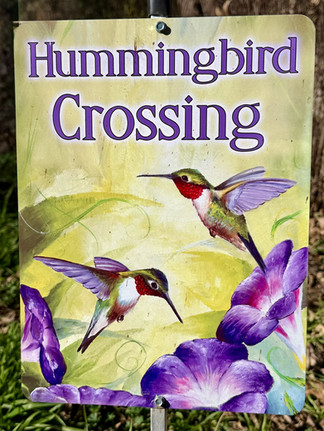


The Paton Center for Hummingbirds
Worth mentioning here is that driving in the southern part of Arizona, close to the Mexican border, there is a very strong presence of Border Patrol with many checkpoints along the roads. As unnerving as this may sound, it made us feel safe. If anyone did have the inclination to cross the border here, this is not the place for it. Border Patrol agents were everywhere and they look very serious, and they have guns too.
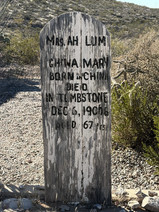
Only one hour drive from the hummingbird centre is the Wild West town of Tombstone, famous for silver mining and street gunfights. Our first stop here in Tombstone was the famous Boothill Graveyard. What an interesting place to visit, almost humorous - actually, it was humorous. We expected this place to be no different than some of the other graveyards we have visited previously, tucked away down a side road with a bit of a sombre feel about them. But Boothill Graveyard is a full blown tourist attraction on the side of a main road. We had to purchase tickets to enter and were given a map with background stories of some of the graves. This cemetery was originally called the City Cemetery when it was founded in 1878 and it served the entire population of Tombstone. In 1884, a newer city cemetery opened and from that point on, this original graveyard was used primarily for outlaws, transients, and those who died violently. In the 1920’s it was renamed “The Boothill Graveyard”. This name derived from “Died with their Boots On”, a phrase which referred to people who died in gunfights, or in violent or sudden unexpected ways. Billy Clanton, Tom McLaury, and Frank McLaury are all buried here. These three men were killed in the famous 1881 shootout at the OK Corral in downtown Tombstone. Of the 256 graves here, 93 are unknown or unmarked. Some of the headstones are quite mystifying, and shall we say even comical to a point. There are many wooden markers that say “unknown” and others that simply say “Murdered”, “Hanged” or “Shot”. Others have a bit more details like “Two Chinese Died of Leprosy” or “Killed by Indians”, politically correct they were not. Still there were many compelling dead stories here. Interestingly this graveyard has a variety of different ethnicities including a Jewish Memorial for Jewish Pioneers which most western cemeteries during those times did not have at all. As well there are Mexicans, Chinese immigrants, South American immigrants and so on.

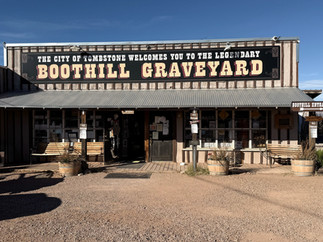







Boothill Graveyard
Still on the subject of graveyards and gravesites. Back in 1993 after filming the movie Tombstone with Kurt Russell who played Wyatt Earp, and Val Kilmer who played Doc Holliday, Kurt gifted Val a burial plot in the new Tombstone Cemetery, and Val gifted Kurt an acre of land that overlooks the cemetery. When asked the meaning Kurt Russell explained “Doc Holiday was all about death, but Wyatt’s all about life”. Val Kilmer died April 1st 2025 and was cremated. He does not have a traditional grave here but there is a memorial on the plot at the Tombstone Cemetery.


Val Kilmer memorial
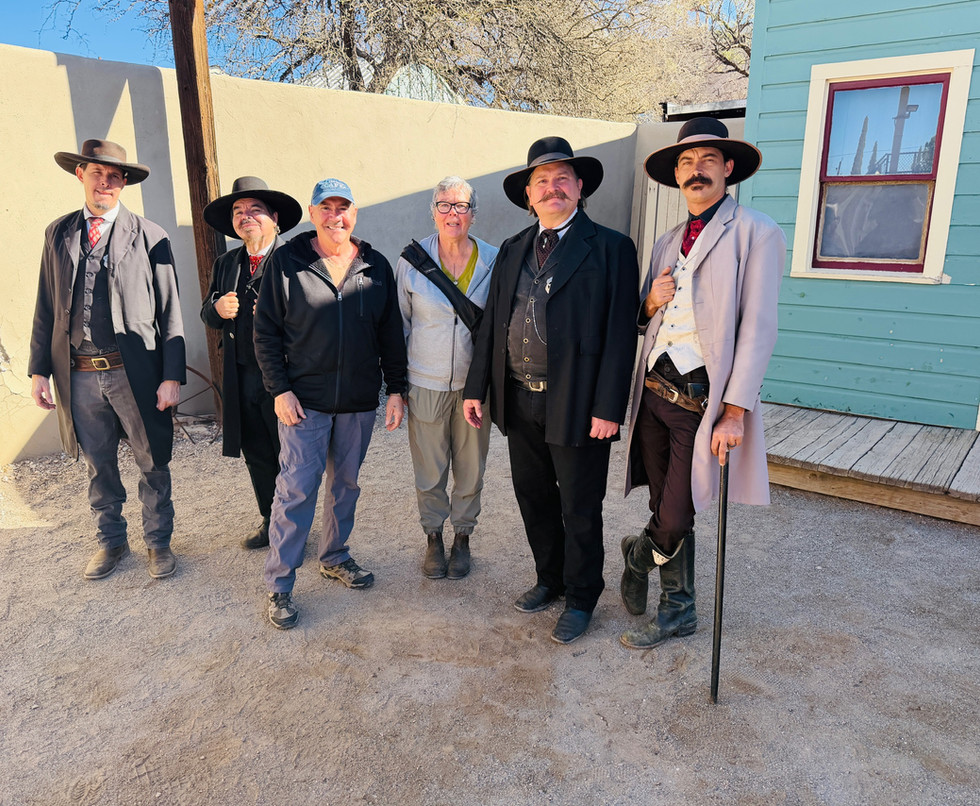
With so many different gunfight reenactments to choose from in Tombstone we decided on the one we have a bit of knowledge about from the movies, the famous Gunfight at the OK Corral. This was a 30 second shootout that took place on October 26, 1881 between lawmen Wyatt Earp, his brothers Virgil and Morgan, and Doc Holliday, with the outlaw Clanton-McLaury gang. The gunfight resulted in the deaths of Billy Clanton, the McLaury brothers, Frank and Tom, and the wounding of Virgil and Morgan Earp as well as Doc Holliday. The acting was good and had a comical twist to it so it made for a fun time. When the initial shooting began I must say we, along with a few other audience members, did jump in our seats because it was loud.


Shootout at the OK Corral
Is it Guy or is it Mike?? One very funny incident that happened for us at the OK Corral was after the show the audience was invited to come up and have their photos taken with the actors. Guy and I of course got up to have our picture taken. There was a large group of men in front of us getting their picture taken, now this group was large, probably close to 30 people. I offered to take the photo so everyone could be in the photo. The group kept calling for “Mike”. Well unbeknownst to me as I am taking the photos Guy decides he would partake in the group photos. Afterwards one of the guys looks at Guy and asks “are you Mike”. Guy did not understand as he thought I was taking pictures of the group with my own phone for our blog.., not sure why I would do that? But now, every once in a while I laugh at him and call him “Mike”. Not one of his proudest moments….

Is that Guy or Mike with me ???
Here in Tombstone is the World’s Largest Rosebush located in the backyard of the Rose Bush Museum. This rosebush was planted here in 1885 from cuttings from a “Lady Banksia Rose” a nearly thornless climbing rose - that originated in Scotland. The cuttings were sent from Scotland to Tombstone to a bride named Mary Gee, who later gave it to her friend Amelia Adamson. The rosebush was first declared the “World’s Largest” in the late 1930s, and has since continued to grow. The plant covers between 8000 to 9000 square feet and is supported by a large trellis system. There are even designated pathways under it for visitors. The trunk has a circumference of between 12 to 16 feet. This rosebush is massive. We were able to easily walk underneath and also to view the top of it from an elevated platform in the yard. From the elevated viewpoint we really got a feel of its enormity. At its highest point it was probably at least 20 feet tall. It is hard to imagine the beauty and aroma of it blooming in the spring with its 200,000 to one million small white roses.


World’s largest rosebush
Yes, Tombstone is what one may describe as absolutely “touristy”. There are colourful wagon rides around the town for a fee. There are souvenir shops, saloons, and restaurants galore. Gunslingers wait on street corners trying to lure tourists to come inside to see their gunfight, as theirs of course is “the best”. But when we looked beyond all that fun and beyond all the tourist facade, and dug a bit deeper, we discovered many interesting and unique stories on the history of this town and the real people of Tombstone.






Tombstone
Tombstone has had two major fires in the past. The first on June 22, 1881 was started at the Arcade Saloon by a cigar igniting a whiskey barrel. This fire destroyed 4 blocks of the business district. And on May 26, 1882 the second fire began in the laundry behind the Tivoli Saloon which destroyed the Grand Hotel and over 100 businesses. On both occasions the town rallied together and rebuilt showing their strength and resilience. One of the few original building in Tombstone is the the Bird Cage Theatre. This building did survive both fires. The building's name derives from the 14 balcony boxes (cribs) suspended from the ceiling where the prostitutes entertained clients, which were called “Bird Cages”. In the basement there was the legendary high-stakes poker game that supposedly ran continuously for 8 years 5 months and 3 days. Many famous players attended like Wyatt Earp, Doc Holliday, George Hearst (father of newspaper publisher William Randolph Hearst), and Adolphus Busch who developed a light lager called Budweiser, and by the turn of the century Anheuser-Busch Brewing Association was the industry's top-selling brewer. There was a $1,000 minimum buy-in and roughly $10 million in chips were exchanged with the house taking 10%. That’s a lot of money now and it certainly was a lot more then. It is said that ten men died at that poker table.


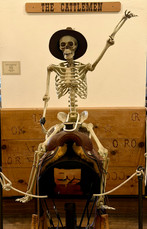
The Courthouse here is a two story Victorian Style building that began construction in 1882. During construction, a kiln was built on site and brick makers were hired to make the bricks to construct the new courthouse which was completed in January of 1883 at a cost of $43,000. The courthouse is filled with interesting stories and artifacts from Tombstone. There is a Replica Gallows in the courtyard where seven men were legally hanged between 1884 and 1900. There is a Wyatt Earp exhibit with some of his personal belongings.




Tombstone Courthouse




Gallow at the Tombstone Courthouse
One of the most interesting items here is a photo that was taken by Camillus Sydney "Buck" Fly. He was a photographer in Tombstone who worked as a photojournalist and supplied images to national publications like Harper’s Weekly. In 1885 Fly heard that General Crook was heading south for peace talks with Geronimo so he equipped a wagon and followed the General's detachment into Mexico to record this event. He photographed Geronimo and nearly all his band, directing them to pose or stand exactly as he wanted. These photos are the only ones ever taken of American Indians on the warpath.




Geronimo - Courthouse Tombstone
Another interesting story we discovered at the courthouse was about a man named John Heath. He was the mastermind behind the 1883 Bisbee Massacre. This was the robbery of the Goldwater & Castaneda store in Bisbee to steal a mining payroll organized by John Heath. He did not actually pull the trigger but the robbery resulted in five deaths, including a lawman and a pregnant woman. His five accomplices were sentenced to death but John received life in prison. This verdict angered the local community in Bisbee so on February 22, 1884, an angry mob from Bisbee broke into the Tombstone jail, dragged John to a telegraph pole on a street corner, lynched him, and hung him from the pole. Now all that remains of the event is the old stump of the telegraph pole and a small plaque to commemorate the event.


Lynching of John Heath - all that’s left, telegraph stump & small plaque
One of the stories in Tombstone is about Sing Choy known as "China Mary". China Mary is a pseudo name that was given to multiple Chinese women who immigrated to the United States in the 19th century. Sing Choy was known as the "Godmother" of her community of the Tombstone’s Chinese district and controlled much of it. She was an influential businesswoman finding jobs for Chinese labourers outside of the Chinese community and helping those in need. She managed a general store, gambling halls, brothels, and opium dens. She also managed the famous Can-Can Restaurant which was a famous fine-dining establishment known for serving exotic items like fresh oysters and shrimp which were transported by refrigerated railcars. She died in 1906 and was buried at the Boothill Graveyard. Her funeral was one of the most attended funerals in the Boothill Graveyard history.


Sing Choy - “China Mary”
Big Nose Kate (Mary Katherine Haroney) was born in Budapest Hungary and immigrated to Iowa in 1865. She worked as a dance hall girl and a prostitute in Wichita Kansas. Eventually she came to Tombstone and ran the first brothel here. She was also the part time girlfriend of Doc Holiday and famously helped him escape from jail in Fort Griffin Texas around 1878. She created a diversion by setting a fire to an old shed near the jail. While the town was distracted by the fire, she confronted the guard with a gun, disarmed him, and escaped with Doc Holliday.


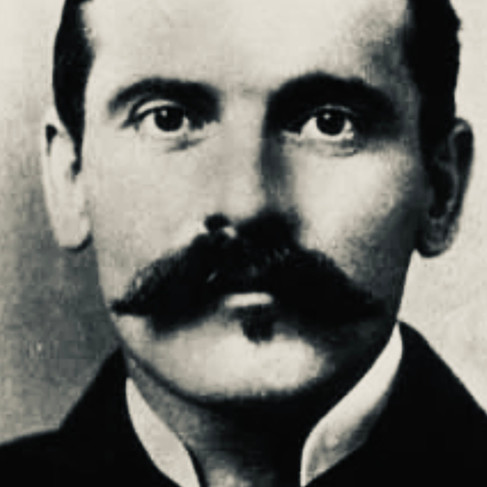
Big Nose Kate and Doc Holliday
And of course there is the founder of Tombstone, prospector Ed Schieffelin. Back in 1877 Ed began searching for silver in the San Pedro Valley. This area was known to be frequented by hostile Apaches and the troopers warned him that all he would find would be his own Tombstone. Within 2 years the miners camp was established and overflowing with miners reaping the rewards of the rich silver in the surrounding hills and the camp became known as Tombstone - and Tombstone was now on the map. In 1880 Ed was offered $300,000 for his claims which he happily accepted. He became a wealthy man but continued prospecting until his death in 1897 in Oregon. Ed had requested to be buried in the desert near the town of Tombstone as he had stated, "It is my wish, if convenient, to be buried in the dress of a prospector, my old pick and canteen with me, on top of the granite hills about three miles westerly from the City of Tombstone Arizona, and that a monument, such as prospectors build when locating a mining claim, be built over my grave... under no circumstances do I want to be buried in a graveyard or cemetery.” And so, such a monument was built in his honour.


Ed Schieffelin and his gravesite memorial
Just south of Tombstone is the vibrant, artistic and oh so colourful town with many stairs to climb called Bisbee. Just before arriving in Bisbee we drove the Mule Pass which is where there is a Continental Divide marker. The story about this marker dates back to 1913 and 1914 when the road over the Mule Mountains was being built by local prisoners. Back then, this road was the only way to Tucson or Tombstone from Bisbee. When the road was finished, the marker was placed here to proclaim the completion of the road as well as to declare the triumph of building pavement over nature. But for some reason the marker also claimed that Mule Pass was right on top of the Continental Divide, the invisible line separating the drainage basins of the Atlantic and Pacific Oceans. This however is incorrect as that line is about 120 miles to the east. In the 1950s the Mule Pass Tunnel was completed which went through the mountains making for a shorter and easier commute.


Continental Divide marker - View of Bisbee - Mule Pass Tunnel
The town of Bisbee was founded in 1880 as a mining town of copper, gold, and silver. Up until the 1970’s it produced over 8 billion pounds of copper, plus large amounts of gold and silver. Bisbee became known as “Queen of the Copper camps” and once was the largest city in Arizona but by 1975 the mines closed. The closure was mainly due to the depletion of ore reserve, the drop in price of copper, and higher wages. Bisbee is also quite famous for something else, its stairs. Due to being located in a mountain region, there is very little flat land in the area, so the town grew up along the surrounding hillsides. Many of the stairs in Bisbee originally began as dirt paths that were used by mules carrying supplies to the houses located up in the hills. These pathways were used to connect the homes to the town center. Eventually the paths were replaced with wooden stairs that looked like ladders, which were then replaced in 1938 with concrete stairs. Many houses in Bisbee today are only accessible via stairs and we were told that because of this some delivery companies will often check the location before agreeing on a cost to deliver a package. It is estimated that there are 33,000 steps in total. There are 82 staircases with approximately 22 of those having more than 100 steps each.


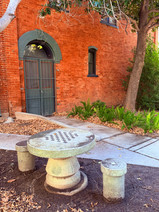


Colourful Bisbee
Every year Bisbee host a race called the Bisbee 1000: The Great Stair Climb. This is a 5K race that includes a total of 1034 steps and winding roads spread over nine different staircases and a total overall elevation change of 1175 feet. Another race here is called the Iceman Competition which involves carrying a ten-pound block of ice up 155 steps with antique ice tongs in homage to the ice delivery men of the past. We decided to experience some of this for ourselves and ventured up and down quite a few of the stairs. It turned out to be quite an interesting experience filled with an array of colours, painted murals, artistically coloured and designed houses and walls, and a variety of sculptures. We did find Bisbee to be one of our favourite towns in Arizona so far and if we lived here we would be in great shape and have great legs! Not sure about Guy’s knees though?











The many stairs and artworks of Bisbee
The Lavender Pit copper mine just outside Bisbee is not named for its beauty or colours but after Harrison M. Lavender, an engineer who worked for the company that owned the Bisbee’s Copper Queen mines. Lavender believed that open-pit mining was the answer to getting more copper ore from Bisbee’s low-grade rock. So in 1950 open-pit mining started. Unfortunately, by this time, Lavender himself had become quite ill and he passed away in 1952. The pit mine was named in his honour. The mine remained in operation until 1974 and produced more than 600,000 tons of copper. There is a tall chain-link fence surrounding the pit along the highway and we were able to stop and view the excavation. The hole is quite massive and deep and the colours on the layers of rocks from the oxidation of the copper and other minerals exposed was quite a sight to see.


Lavender Pit mine
Just a little further drive down from the Lavender Pit mine, was a successful cooper mining town called Lowell. Lowell was almost completely demolished in order to expand the Lavender mine in the 1950s. Over 250 homes and businesses were either destroyed or moved. Lowell as a result almost became a ghost town, or as some describe it a “partial” ghost town. Lowell was incorporated into the town of Bisbee in the early 1900s, making it a neighborhood rather than a standalone town. We stopped there to checkout “Erie Street”, the only original street left in Lowell which is like walking back in time to the 1950s. The street is now staged as a tourist attraction with old cars, trucks, a couple old Greyhound buses parked along the street. There is an old style gas station at the end of town, storefront shops with original signs along the street, and the old police station still stand with vintage police cars parked in front. It was neat just wondering around taking in all the memorabilia of the 1950s.


Historic Erie Street
Further south is the town of Douglas Arizona. Douglas is a nice small town on the border with Mexico, considered to be “The Gateway to Mexico”. Driving here we had to be diligent with our directions because one wrong turn and we would of ended up in the line up to Mexico and a detour into Mexico is definitely not part of our plans. An interesting bit of history of Douglas is starting back in 1928 the Douglas Municipal Airport was set up so that airplanes could taxi directly across the border into Mexico. And, in 1933, the Douglas Municipal Airport became the first International Airport in the Unites States designated by Eleanor Roosevelt. Another bit of history here in Douglas is at the Gadsden Hotel. This hotel opened in 1907 and was rebuilt on an even grander scale in 1929 after a fire destroyed it (no correct documentation to the cause of this fire). All that survived of the building were the four marble columns with hand-layered 24 karat gold leafing, the grand staircase made of Italian marble, and the elevator car which is the oldest manually operated elevator still in use west of the Mississippi. In the lobby now, there is a massive 42-foot Tiffany stained glass mural and vaulted stained-glass skylights. It is said that Pancho Villa once rode his horse up the grand staircase and many famous people including John Wayne, Amelia Earhart, and Peter Fonda have stayed here.


Gadsden Hotel
History aside, Douglas had a few other intriguing stops for us. The first was The Last Supper Museum. This quirky little museum has the world’s largest collection of art inspired by Leonardo da Vinci’s "The Last Supper”. Eric Braverman, or “EB” as he refers to himself, is the curator here and lucky for us he was there the day we visited. Now EB is quite the character, loads of fun, full of energy, he could not stand or sit still for even one minute. He has an amazing amount of knowledge of all the pieces in his museum. He began collecting these pieces over 50 years ago when on a family trip to Hollywood his parents bought him his first piece, a snow globe of the Last Supper. EB has led an interesting life working in the recording and music industry with heavy metal bands such as Slayer and Metallica, of which he is quite proud. According to him, there are about 600 pieces of the Last Supper on display now in tne museum and another 2000 still in storage. The total collection is comprised of art pieces from approximately 50 different countries. This is truly an amazing place. He explained to us that this collection is a combination of two collections: his and a second which is a major collection he acquired from a previous Indiana-based museum owner. The deal for acquiring the second collection was “he could have it as long as he only took money by donation and used the donation money to help community and not profit from the earnings”. As a result of this agreement, he has established a thrift store next door to the museum which offers clothing, meals, and articles for those in need as well as a yearly scholarship program to the local community college.


Last Supper Museum
Some of the pieces here are serious and some are a bit more on the quirky fun side. There are Last Supper displays created from Pez dispensers, eyeballs, UFOs, Charlie Brown, cutlery, Day of the Dead paintings, and one made from slippers fittingly named “The Last Slipper”, just to name a few of the fun ones. There is a copy of the original Last Supper painting, an African diorama that is made from the fibres of banana peels, wooden sculptures, and oil paintings. There is a last supper painting of only women around the table. There is a framed depiction of the last supper made by a prisoner in jail; his girlfriend brought it in and a friend of EB’s bought it and donated it to museum. Apparently, this prisoner sold this to collect money to hire a lawyer for his defence, we did not ask about his crime. The museum had just received this piece so EB had not been able to display it properly yet but he did share the interesting story. In the back room, EB was in the process of assembling a large staged exhibit of the Last Supper with life sized statues that had recently been donated to the museum. Visiting this little museum made us laugh. It was just so full of fun, stories, and history. We left this place with a sense of hope - hope that such a little place can make such a big impression on all who come through. We hope to find many more of these little gems.

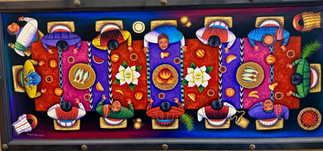






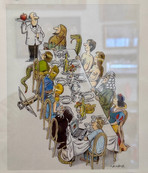








The never ending Last Supper
Before leaving we showed EB a photo and told him about the painting of the Puffins Last Supper in Bulls Bay Newfoundland we had seen last year. The painting hung in the lobby of a restaurant. EB was so excited and said he would contact the restaurant to see if they would consider donating it to his museum, or at least a copy of it. He gave us his contact details and said if we came across any more Last Suppers on our travels to let him know. Pretty sure we will see more, maybe not as odd and quirky as the ones in the museum, but I’m sure there are lots out there to be found.


“Puffins Last Supper” - we just have to share this again its one of our favorites!
Art Car World was another of our stops here in Douglas. An art car is a street-legal vehicle that has been transformed into a work of art. Most of these artists are self-taught and self-funded individuals who use their cars as their primary mode of transportation, and at the same time to express their unique ideas, values, beliefs, and dreams. The art car movement is growing and includes a few categories. Paint Cars - these are vehicles with words or patterns painted directly onto the surface. Glue Cars - these are cars with attached items, which can include litter, dolls, jewelry, rubber ducks, as well as functional items such as musical boxes and cameras. Sculpted Cars - these are cars with large sculptures and shapes that are attached directly to the cars body. Message Cars - are cars used by artists to express a specific message either personal, social, or political. And Interactive Cars - these are cars used to encourage public participation. So as we can see there is quite a variety of these cars. This museum now has a permanent collection of over 28 art cars, vans, and motorcycles; as well they continuously host exhibitions of art cars. Currently the museum is undergoing renovations so they only had some of the cars on display - still quite amazing to see.


Art Car World
The first car we saw was the Camera Van, a 1972 Dodge Van covered in 2750 cameras - 10 of which are still functional and used to photograph peoples reactions to the display. This car was created by Harrod Blank, the owner of the museum, in the mid 1990s. He drove the van across the USA twice, as well as in the United Kingdom. The idea of taking photos of onlookers came when he had video camera feeds into a TV set inside the van to record his travels. When he saw the facial expressions of some of the onlookers on the monitor he got the idea and decided to start capturing these by triggering one of the vehicle's five working cameras. Harrod apparently now has more than 2000 photos of onlookers with various expressions which he is planning on making into a book.


Camera Van
Harrod, as you can imagine, is a bit of an interesting man. He is described as an artist and filmmaker. He did some small acting parts in films like “Killer Klowns from Outer Space” and “The Last Boys”. There are movie posters and clown heads included as art on the walls in the museum. He directed a documentary about Leonard Knight and Salvation Mountain in 2025 (we went to Salvation Mountain in Slab City California just recently) and he has been working on a Burning Man Documentary for the last 30 years.




Art Car World
Other cars we saw here includes one called “Oh My Gawd!” which is a 1965 VW Beetle decorated with a chalkboard, plastic fruit, plastics dolls, and rubber chickens. Another called the Leopard Car, has over 600 cats attached to it. Some of these cars are fun, some interesting, some intricate, and some downright confusing. One car has 48 working music boxes on it which took the artist almost 2 years to complete. We were able to wind up some of the music boxes. There is a Corvette covered in jewelry; a husband, apparently used his wife’s collection of costume and real jewelry - some of which are real rubies and diamonds, as a way of dealing with his grief when he lost his wife. There is a Coltmobile plastered with 1000 horses glued on to it. There is a beautiful Volkswagen Beetle called the Glass Quilt which took the owner 15 years to create; the car has over 1000 glass marbles from eight different countries glued to it. One of the other cars here has so much stuff attached to it, it is difficult to figure out what it represents. This car weighs 10,000 pounds and has over 400 belt buckles, $1500 in coins, and 1500 letter openers. Elvis Presley, Willie Nelson, Bruce Lee, and John Wayne have all sent gifts for the owner to attach to this car, including a brass Buddha, knives, and letter openers. There is also the car with tulips painted on it displayed here which was a wedding gift to Miss Vicky and Tiny Tim (the song “Tiptoe through the Tulips fame), who got married on the Johnny Carson TV Show. Another beautiful car was another full size Volkswagen Beetle, but this one was entirely shaped out of iron rods. It also had a beer keg for a gas tank. We were told that this car was crafted by a Mexican man who owned an auto repair shop. He apparently built the car without having measurements, “he remembered the size and shape from VW cars which he repaired”. His rod iron car was used in parades and weddings. A bit breezy though - apparently the brides were not so impressed with their hair and dress flying around in the wind…. An interesting fact worth mentioning, we found out that almost 70% of the cars in the museum are made by women.





A few of the many art cars
We were to meet up with my sister Michelle in Tucson for a few days at the end of January. Before that, our plan was to travel to a few places in southern New Mexico and then return to Tucson for the visit. But once again Mother Nature had a different idea for us and our plans changed. It was cold at night in New Mexico with the temperatures dropping to -7 Celsius. We could not take the chance of our waterlines freezing and possibly bursting. Plus, we have to admit, we’re tired of being cold. So we decided on a quick and only stop in New Mexico for now in Lordsburg to visit the Shakespeare Ghost Town. After Shakespeare we would head back towards Arizona where the weather is much warmer.
Shakespeare is a privately owned ghost town located not far from Lordsburg New Mexico. This town was originally a stagecoach stop known as Mexican Springs and then a mining town known as Ralston City back in the 1800s. The town is also famous for the Great Diamond Hoax of 1872 which involved financier William C. Ralston, whom the town at that time was named after. He scammed investors with a fake "diamond field" which was "salted" with gems. This significantly impacted the towns reputation and the town almost became deserted. The town was renamed Shakespeare in 1879 by Colonel Willam G Boyle a mining investor who had taken over the mining claims and was trying to rebrand the town. The new name was suppose to create a respectable image. The Main Street was called Avon Street and the Stratford Hotel was built. There was a bit of a second mining boom but the mines closed completely in 1929.


Shakespeare Ghost town
There is also lawlessness and Wild West history associated here. The saloon which is part of the Grant House Dining Room and Saloon still has bullet holes in the walls where cowboys supposedly took turns shooting at flies on the walls and vigilante justice was the norm. In 1881 cattle rustlers “Russian Bill” Tattenbaum and Sandy King were both hanged from the rafters of the Grant House and it is believed that Billy the Kid when he was younger washed dishes at the Stratford Hotel. In 1935 ranchers Frank and Rita Hill bought the town to save it from ruin and it has remained owned by their descendants to this day, who now operate it as a historical site. Shakespeare has about 7 to 8 of the original buildings including a blacksmith shop, a general store, a hotel, and saloon in different states of repair. The owners are trying to do renovations to keep the buildings alive and standing, while still keeping the authenticity of the Wild West atmosphere.


The Saloon
Keith was our guide here and we must say a bit of a character. He definitely knew his stuff and the history of this place but his bouts of coughing and bit of memory lapse sometimes made it difficult to listen to him completely. Not sure if he was adjusting to the dry climate, age, or just too many years of smoking cigarettes. Anyways he was still enjoyable and did share quite a few stories and information. One of those interesting pieces was about “Stringers”. These were newspaper journalists retained by newspapers to find news stories. They would ride the rails going from one town to the next looking for news stories. When they did come upon one, they would send a telegraph back to the newspapers to publish and according to Keith, that is how the news worked back then. Another big plus here is that they allowed us to boondock for the night in their parking lot, which was great. The night was quiet, restful, and quite dark with a clear sky so we enjoyed the stars.





Shakespeare Ghost Town
In New Mexico, on the way to Lordsburg, is The Geronimo Surrender Monument. This monument stands eight miles away from the actual site of the Geronimo's surrender. On September 4, 1886, Geronimo and his band of followers surrendered to General Nelson Miles at Skeleton Canyon in Arizona. The history of Geronimo is really quite fascinating. He was born in June of 1829 in New Mexico which at the time was Mexico, into the Bedonkohe band of the Apache tribe. His grandfather was a chief of the Bedonkohe tribe and Geronimo was trained to be a Medicine Man. When Geronimo was 22 years old his camp was attacked by Mexican soldiers. He and most of the Apache men were away at the time and when they returned many of the women and children had been killed, including Geronimo's mother, wife, and his three children. From this time forward until 1886 the Bedonkohe, under Geronimo's leadership, fought against Mexican and American forces, resisting the expansion into their territory. His attacks made him a famous Apache leader for his ferocity and efficiency. He led three rebellions against the United States. They were eventually tracked down and a US soldier named Captain Henry Lawton that Geronimo respected was sent to talk with him. He was able to convince Geronimo to surrender, and promised that he and his band would not be slaughtered if he agreed to do so. Lawton then escorted Geronimo and his followers to Skeleton Canyon where General Miles was camped and where Geronimo and his band surrendered.


The Geronimo Surrender Monument
Sadly, Geronimo spent the rest of his life as a prisoner of war. The Territory of Arizona wanted to have him executed for his “guerrilla warfare” so the US Army had him and his family transferred to a base in Florida to prevent this from happening. Somehow a group of businessmen in Florida convinced the military authorities to allow them to display Geronimo in his prison cell as a tourist attraction. In 1894, Geronimo was transferred to Fort Sill in Oklahoma where he was given a small plot of land within the base to build a house and farm. He was still in prison and not allowed to leave without an armed military escort. He was put on display again for tourists at the Pan-American Exposition in Buffalo in 1901 and the World's Fair in St. Louis in 1904. In 1905, Geronimo rode a horse in President Theodore Roosevelt's inaugural parade. After the parade, Geronimo met with Roosevelt and begged him to allow the Apache people to be freed from their prisoner of war status. Roosevelt refused telling Geronimo that he had a “bad heart,” and that he and his followers “were not good Indians.” Geronimo died on February 17, 1909, still a prisoner. It is said that on his deathbed, he voiced his regret at having surrendered wishing instead to have fought to the bitter end. Such sorrow to the ending of this story. The monument, on the side of the road at Skeleton Canyon, does not possibly convey the justice, the memory, or the sacrifices that were made.


Geronimo
That evening we drove to the Chiricahua National Monument. Because the campground was completely booked we decided to boondock for the night on the side of the road just outside the park. We had a wonderful peaceful night viewing a beautiful colourful sky with the backdrop of the Chiricahua Mountains - another one of our amazing boondocking moments to remember. The Chiricahua Mountains are referred to as “sky Island” for their unique features of volcanic rhyolite pinnacles and balanced rocks which were created through a combination of volcanic activity and millions of years of erosion. In the early morning we started the 16 km scenic Bonita Canyon Drive to Masai Point which is 6,970 feet above sea level. Along the drive we stopped to admired the Organ Pipe Formations. This is a huge wall of hoodoos formations that resemble organ pipes, they are a few hundred feet tall and are over 27 million years old. Guy calls them “natural sculptures” and they are spectacular. How do these giant rocks possibly stay balanced on top of each other?Some look like they are hanging by only a tread - a little worrisome, to say the least, as we walked below them. The drive was full of so many awe moments and surrounding beauty. At the top of the mountain we did a few short hikes and were even greeted with snow on the paths. It was cold but it felt good to feel that crispness and lightness of the air. And the views of course were breathtaking.


One of those boondocking moments outside the Chiricahua National Monument





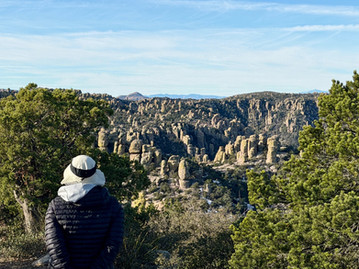





Chiricahua National Monument
As we were a few days ahead of schedule for arriving in Tucson to see Michelle, we made our way to a donkey rescue where we spent one night. Worth mentioning here is that along our way we saw a funny highway sign that said “Bush Fire Extreme Use Ashtray”. We can only imagine what that means, but isn’t it common sense…?
Forever Donkey Rescue was high on our list - one of the places we had been looking forward to visiting for a while. The sanctuary is a Harvest Host stop so we were able to both visit and stay the night. Tish and John Hiestand purchased a 30-acre property just outside Benson Arizona where they built their home. In 1997, for Tish's birthday, John bought her a donkey named Blackjack for $50. Blackjack lived with them for 26 years. Well if you have one donkey you surely need another to keep the first one company which is what John and Tish did. Unfortunately BlackJack's first companion had to be put down due to health issues. They advertised for another companion for Blackjack and were overwhelmed by the number of people who wanted to give away their donkeys because they couldn’t or wouldn’t care for them anymore. John and Tish opened their hearts and their land and decided to adopt more and more donkeys. They began to notice they were getting donkeys that had no chance at a “normal” life as they had severe medical, behavioural, or special needs. And soon they were homing donkeys that had no place else to go. As a result, most of the donkeys at the sanctuary will now live out the rest of their special lives being loved and cared for. Sometimes they do get donkeys that are young and healthy and they try to find happy homes for them.


Forever Donkey Rescue
At the beginning, their place was meant to be a private home for rescued donkeys, but when Suzanne Velasquez came onboard, as a volunteer, she helped make the sanctuary into the All Volunteers Nonprofit rescue it is today with now over 34 donkeys and 15 volunteers to help. Every one here at the sanctuary knows all the donkeys names, their backgrounds, their special needs, and their quirky and sometimes naughty habits. Some of the donkeys names are Beefy, Alberto, Kris Kristofferson, Waylon Jennings, Bella, Salsa, and of course The General who greeted us when we arrived. The General is one of the oldest donkeys here and he followed us around like a dog. He nudged us for treats, pats, and ear rubs. He, along with most of the other donkeys, are all so calm and gentle, and surprisingly soft to the touch. A few donkeys were quite nosey and tried to peek into the Roadtrek. Treme, for her part, was not overly impressed by all this and preferred to stay inside. We were warned though to keep her at a safe distance from the donkeys as they are very protective of their environment and can be aggressive with dogs.


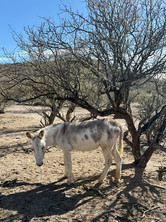


Forever Donkey Sanctuary
The staff here had so many stories to share about the donkeys. One donkey has a broken ear and a cut mouth as he was used for practise roping by the previous owners. John and Tish shared a funny story of how they had helped a stranded motorist when they were traveling to Texas one time. The motorist was a potato farmer from Pennsylvania and would send John and Tish boxes of potatoes for years afterwards. Because the entire sanctuary here is fenced so the donkeys can roam freely during the night and at certain times during the day, deliveries are left outside the gate on a small platform. Well, when the potatoes were delivered they were in cardboard boxes, the donkeys would pull the cardboard boxes through the fence and have a cardboard box feast leaving all the potatoes scattered on the ground uneaten. As John said “I guess donkeys don’t like potatoes?” We were told that donkeys will eat just about anything that contains fibre - with the exception of potatoes we guess. A donkey has a very highly efficient digestive system so their bodies absorb 95% of what they eat. And because of this, at the sanctuary, their diet must be closely controlled or they could otherwise easily become obese living in a confined area.
All donkeys are brought to their individual pens for feeding and, lucky for us, we were able to help getting them to their pens and observe the feedings. The feedings are very methodical with each donkeys diet designed to their very specific needs and the food is precisely weighed and measured. Some of the pens have signs with dietary restrictions like “no carrots” for example. John told us that in the wild donkeys don’t get fat because they continually walk around the desert in search of food. Whereas here, their walking distance is minimal in comparison, they could therefore get overly fat if not controlled.


Donkey, donkeys, and more beautiful donkeys!
Donkeys are highly intelligent and for their size are stronger and more durable than horses. And they are great guardians of their environment. They can see all 4 of their feet at the same time which helps them navigate on tricky terrain. Their large ears are great for hearing and they can live up to 50 years old. One downside is because their coat is not waterproof they do not like the rain, I guess that’s why they thrive in the desert environment. A lot of people here adopt donkeys as pets and companions and take them hiking and camping so they can carry their gear. As well they are great for protection and of course the best of company, we are told.
In the office is a photo of Black Jack just before he passed in the early morning taken by Suzanne Velasquez along with these words that she wrote:
“To be the first animal at a rescue is to be a pioneer, a beacon of hope, a testament to the potential for change, and a symbol of the countless lives that will follow in your hoof prints.” Suzanne Velasquez


Beautiful Black Jack just before he passed
It sums up Forever Donkey Rescue in a heartbeat with the love, respect, and openness that we experienced here with Suzanne, Tish and John, as well as the volunteers, and all the beautiful donkeys that we met while we were there. Over the years of travel, Guy has collected a few horseshoes. Each horseshoes he has brought home carries a special story for us. He has horseshoes from the Grand Canyon, Japan, and Morocco. Well to his surprise and joy he was gifted a “donkey shoe” (a bit smaller than a horseshoe). The shoe came from a small female donkey named Salsa at the sanctuary who has feet issues, who we had met, fed, and petted. This shoe will hold a very special memory and story of the visit to the Forever Donkey Rescue for us. Tish told us that one day someone told her that “everyone leaves here with a smile” and we certainly agree because we both left with huge smiles for the day. And now as we write this and remember our time there, that smile has returned.


Guy with one of his prize possessions - Salsa’s donkey shoe
After all the desert dust and donkey snot and slobber, a shower was a much needed treat. As mentioned previously, we headed for Tucson a few days earlier than planned because of the colder weather in New Mexico. So after the donkeys, we drove to the KOA campground in Tucson where we spent a few days camping before moving into a two bedroom cabin when Michelle was to arrive. For our first night in the cabin it was raining buckets and a bit chilly. And darn it, we soon discovered our cabin ceiling was leaking - it was raining outside and inside. After a few towels on the floor, a few conversations with management, and a bit of shuffling around we did sort everything out. We moved into another cabin. As good as that sounds, we’re all a bit disappointed with the weather. We had hoped for hot, dry, and sunny weather with some time spent by the pool. But again Mother Nature had a different plan. Our dreams of lounging around the pool getting suntanned became non-existent…. But there were still a few fun things to do in Tucson. The KOA campground was full of lemon, orange, grapefruit, and lime trees. And the best part of this was we were allowed to pick to our hearts content. The oranges were so delicious, like candies right off a tree. We collected a few bags. Michelle, for her part, kept collecting lemons and oranges on every walk we went on. She did pack some in her suitcase and later sent us pictures of her lemon cake she had baked with the lemons.


Fresh picked oranges
Our visit with Michelle was filled with fun and laughs. We ate, drank wine, had S’mores over a fire, played Bingo where I won twice, quite a rarity for me. Each night we played a new card game called “The Famille” which Michelle had brought. To her son Owen’s urging, they had bought the game at the Louvre in Paris during their family trip to Europe this past summer. The game was a lot of fun and interesting - good choice Owen.
We ate (a few times) at the EL Charro Cafe in downtown Tucson. This cafe was founded in 1922 and claims to be the oldest Mexican restaurant in the United States that has been continually operated by the same family. The lineup was long to get in but well worth the wait as the food is authentic Mexican and delicious! We also went to Barrio Bread, this bakery is famous with the locals and there is usually a line up the sidewalk to get in. The owner, Don Guerra, was a school teacher turned baker. He had left his teaching job and set up a shop in his garage making his breads, and first started selling to his neighbours. Barrio means “neighbourhood” in Spanish. The grains and wheats he uses are mostly locally grown. He does not use commercial yeast in his breads, instead he uses what is called “natural leavening” - a sourdough starter, whose fermentation incorporates ambient yeast and bacteria. The place is tiny, a bit on the expensive side, but the bread is absolutely delicious! Each day they offer, free of charge, their leftover starter which was not use for their baking that day. Sadly they were out of it when we went.


Tucson fun!
Also on the fun side, Michelle was really keen to see cactus plants in the wild so her and I drove the Cactus Forest Drive. This drive is just a short distance from Tucson in the Saguaro National Park with the backdrop of the Rincon Mountains. The drive itself is only 13 km and we stopped at every scenic view point to take photos and admire the spectacular views. We did a short hike and crawled a bit around the Javelina Rocks keeping an eye out for snakes and scorpions in every crevasses. And of course we had to make a stop in the gift shop. All and all, this scenic excursion took us the good part of the day.


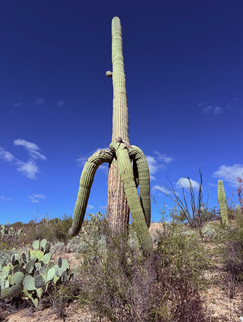





A few more cacti for Michelle
Our plans for the next day were to visit the Old Tucson area to see some of the historic architecture, wander around, and do some shopping. Well who knew that on “Mondays” almost everything is closed. Now I knew because of previous experiences that most museums could be closed on Mondays. But shops? Really? Oh well we did have fun and saw some interesting architecture and of course we ate at El Charro’s again as it was just around the corner. It’s funny how the time flies. Our four days in Tucson with Michelle had already come to an end. She had to fly home to Buffalo and enjoy the winter snow now. Guy and I, on the other hand, will make our way to Quartzsite and then Yuma for the month of February. Thank you Michelle, it was beautiful to see you. We loved our time spent together.

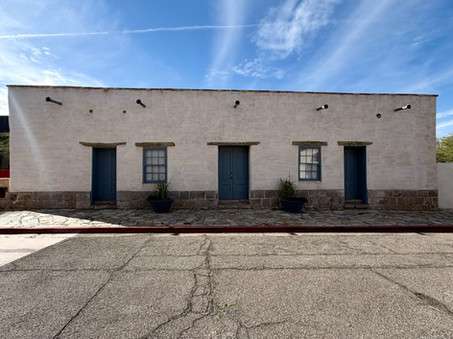


Some of the sights around Old Tucson
There is a place in Tucson called Garden of Gethsemane. On display here are Artist Felix Lucero hand-sculpted statues of Christ with his disciples at the Last Supper, and on the crucifix. Back in World War I Felix was seriously injured on the battlefield in France. He made a deal with God that if he survived he would use his skills as a sculptor to create religious statues. After the war he returned home, and in the late 1930s he lived in Tucson in a shack under the Congress Street Bridge where he started making good on his promise. He began sculpting detailed life size religious sculptures depicting The Last Supper and Christ on the Crucifix. He made these using damp sand and debris he found from the nearby riverbed. He reinforced them using metal objects like old bed frames and rebar he found and the sculptures had a protective layer of plaster or concrete added. Felix Lucero died in 1951 but left quite an extraordinary legacy. This garden is located close to the hectic and chaos of downtown Tucson but we felt a sense of peacefulness and calmness as we wandered around these statues admiring his work. Interestingly, the sculpture garden is very close to the very bridge Felix had once lived beneath.


Garden of Gethsemane
We never know what we will encounter with some of the museums we visit. Some have been a bit of a disappointment but some have exceeded our expectations and the Mini Time Machine Museum of Miniatures is one of the latter. This museum is 10,000 square feet and has over 500 miniature houses and room boxes. There are antique dollhouses dating as far back as 1742. There are mechanical houses, decorated eggs, and a collection of 52 miniature dolls each made from a single grain of wheat.


Collection of 52 dolls each one made with a grain of wheat


Collections from the Mini Time Machine Museum of Miniatures


Mechanical House created by Emil Wick
At the museum there was a display by Ray Harryhausen. Harryhausen is an America-British stop-motion animator and visual effects creator famous for his "Dynamation" process. Dynamation combines live-action footage with stop-motion animation, allowing human actors to appear as if they are interacting directly with miniature creatures in scenes. Example for miniature creatures would be the Medusa with her many moving serpents for hair or Bubo the mechanical owl, both were used in the 1981 movie Clash of the Titans. Harryhausen style and process has had a major influence on directors such as Steven Spielberg, Tim Burton, George Lucas, and Peter Jackson. One display showed how rabbit puppet heads with many different expressions was used in the Tortoise and the Hare. Different expressions were used in fractions of second intervals moving from one segment to another giving the impression of fluid motion; the same was used for body positions and movements. Also on display were many different “Key Drawings” which Ray used to help illustrate important characters, scenes, and exciting encounters in a script from The 7 Voyages of Sinbad and Gulliver Travels just to name a few. Some of his hand-crafted armatures were also on display.






Ray Harryhausen Art works
In the museum there is a display of Japanese Netsuke. Netsuke are intricate miniature Japanese sculptures originally used to secure the cords of a person's sagemono (personal pouch) the small container that hangs from the kimono belt (obi). As Kimonos do not have pockets the sagemono contained a person's everyday essentials and money. Netsuke were a necessary fashion accessory. They were worn by both everyday and wealthy people. At first glance these small carvings appear to be just small decorative figurines, but with a closer look small holes in the carvings where the cords were laced through can be seen, making these Netsukes.

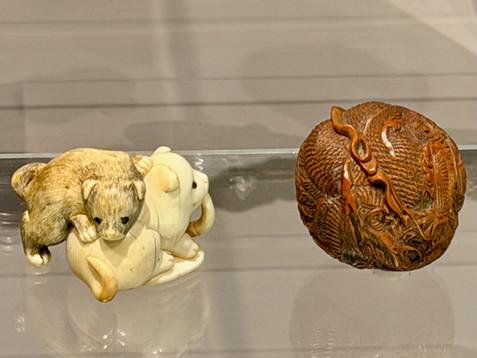





Japanese Netsukes
There is also a display of Chinese figures sculpted from bread dough known as “mianhua” or “miansu”. This is a folk-art tradition that dates back to 206-220 AD. The small sculptures were originally created as ceremonial sacrifices and evolved over the centuries and are now used as decorations for weddings, festivals, or funerals. The dough is made from flour, glutinous rice, honey, powdered sugar, and food colouring. This folk-art tradition is passed on by oral teaching and practice. Artists create their figures on the ends of bamboo sticks using a variety of tools. Some of these tiny figures have intricately fine details including teeth, fingernails, and eyelashes!


“Mianhua” or “Miansu” dolls made from bread dough
We came upon a whole display of Kewpies. These are incredibly cute and playful dolls that are worth mentioning. Rosie O’Neill was an American cartoonist illustrator and writer, and the creator of these cute cherubic winged dolls. These dolls first appeared as illustrated cartoons in the Ladies' Home Journal in 1909. They are inspired by Cupid and are designed to do good deeds. Their image soon started to appear in comicstrips, on cards, plates, pillows, boxes of cereal, Jell-O boxes, and many other products. The first Kewpie Dolls were made of unglazed porcelain in 1913-1914. Later the dolls were made of celluloid, plaster, wood, rubber, and eventually, plastic. The dolls became a worldwide phenomenon and made Rosie O’Neill a millionaire.


Kewpies


More cute and fun characters
One of the most intricate and awing display here is by Russian artist Salazar Fidai. He creates sculptures from the tips of No. 2 pencils. He uses only an X-Acto knife, strong light, and sometimes a microscope. He can spend up to 6 to 12 hours or days on a single piece. He explains his art as: "The technology is very simple, I take a pencil and remove the extra.” We saw three of his art pieces on display: a person, a horse, and a birdcage. It is still hard to believe how he can possibly have the patience to create these, it is truly amazing.


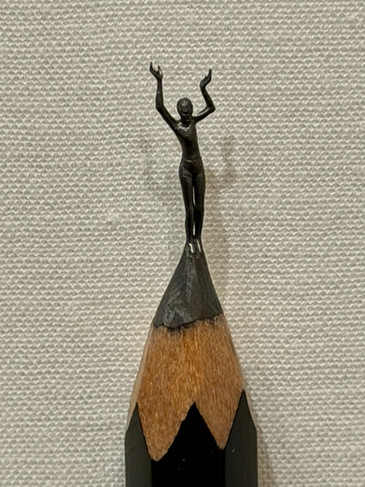


Amazing art pieces - hard to believe these are carved on the tip of a pencil!
We have named only a few of the numerous unique and amazing exhibits on display here. Oh how we wanted to pick up some of these tiny pieces and turn them over and admire their intricacies and details, just to grasp the sheer smallness of their size. But, understandingly, everything was displayed behind glass so no one gets that opportunity. If we listed and described everything we saw and were amazed by at this museum, we honestly would need to write a book. It is way beyond our understanding how anyone could possibly have the patience and will to design these creations that are so tiny and fragile.


More from the Mini Time Machine Museum of Miniatures
Our last stop of the day was at the DeGrazia Gallery in the Sun. What a beautiful place. Ted DeGrazia was a famous painter and sculptor. He was born in the Eastern Arizona mining camp of Morenci in 1909. His parents were Italian immigrants and when Ted was 11 years old they returned to Italy to live. When Ted was 16 the family decided to return to Arizona. My reason for mentioning this is because I find the following facts absolutely amazing, somewhat humbling. Ted at 16 years of age after returning to Arizona, started his first grade at school, he graduated from high school at the age of 23. He attended the University of Arizona in Tucson and earned three degrees: a Bachelor of Arts in Art Education, a Bachelor of Fine Arts, and a Master of Arts in Art Education. I think this just shows the character and resilience of this man.


Ted DeGrazia
He painted mostly oil on canvas and by the 1940s he had mastered the art of the palette knife so most of his paintings he did not use brushes. He also worked with watercolours, sketches, ceramics, charcoals, and mixed media. We were told at the museum “he could make art out of anything”. Many of his pieces are displayed throughout the gallery. The movement, the colours, the feelings and emotions that so much of his artwork evoke create magic. Exploring this gallery was based on pure emotion. His work focuses primarily on the Southwest scenery, horses, desert, bull fights, music, local native folks, and children. One of his most famous pieces is “Los Ninos” (the children) which became a UNICEF Christmas card in 1960 selling well over 5 million boxes. Ted left the faces blank in a lot of his artwork because he felt by omitting facial features whoever was viewing the artwork could use their own imagination and memory to "fill in" the faces, allowing the paintings to represent anyone.


Ted’s famous “Los Ninos” and other paintings and sketches of children
In 1976 Ted made international headlines when he took approximatley 100 of his paintings on horseback to the Superstition Mountains near Phoenix and set them on fire. The paintings were valued to be worth over 1.5 million dollars. He did this as a protest for inheritance taxes on works of art.


Ted DeGrazia setting fire to his paintings
In 1950 Ted purchased 10 acres of land in the foothills of Tucson to escape the hustle and bustle of a growing downtown Tucson and to build the “Gallery in the Sun”. He designed and built the Spanish mission-style complex himself. In 1952 with the help of his wife and a group of friends, using adobe bricks that they made themselves on site, they completed the first structure, the Mission in the Sun. This is a small chapel with an open air roof, interior murals painted by DeGrazia, and was dedicated to Our Lady of Guadalupe and honours Padre Kino.


Mission in the Sun - small chapel
The main building came after and is over 16,000 sq ft with 13 rooms of art. Grass and mud mixture used in the walls construction, which is still clearly visible, adds to the beauty and decorative style of the building. Relief etchings and decorative bricks on the floors make the building itself an amazing piece of art. We were able to wander around the property and enter a few of the selective buildings. We visited the small chapel. We visited another building which is a small gallery built for visiting artists - at the time we visited we were please to witness a young lady working on her paintings. One of the buildings which she described to us as a “time capsule” was the original house where Ted and Marion lived.
This house included built-in furniture and a huge adobe style fireplace.


Some of the many paintings and sketches of Ted DeGrazia


Pottery and sculptures of Ted DeGrazia


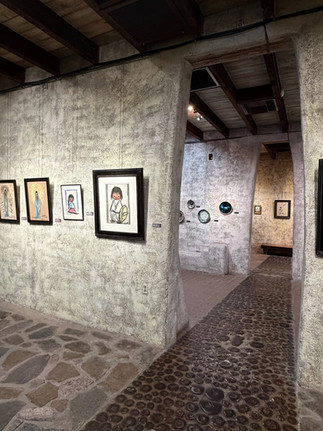


The main building itself is a piece of art


Ted and Marion’s original home
Outside the main building is a beautiful enclosed garden with artwork scattered about and a Koi fish pond. The Gallery in the Sun opened to the public in 1965. It is now a protected historic site. As Ted DeGrazia stated “ The gallery was designed by me, I wanted to have the feeling of the Southwest. I wanted to build it so my paintings would feel good inside”. Well we both must say he very much succeeded.


Outside garden area





Outside area and artwork
Quartzsite in Arizona is very famous with the road travelling communities; it really is a town of its own. A bustling intersection of activity with travellers passing through and camel statues are displayed everywhere. It is considered to be the “RV boondocking capital of the World.” The year-round population here is around 2,400 people but in the months of January and February it is estimated that between one million to two million visitors converge on the town. RVers, snowbirds, and nomads come here to boondock on BML for months at at time for free, or almost free. Gem and Rock Show participants, Trade Show buyers and sellers, and people like us just passing through trying to experience the unique energy and feel of this place. We did boondock here for 4 nights and it was a neat experience that cost us nothing. It wasn’t quite as remote as we expected it to be as there are people camped everywhere. There are some unique communities of people here and we felt honoured to be a small part of it all. It was definitely a different feeling when we looked out on the vastness of desert and could see never ending trailers, vans, and campers everywhere taking advantage of the free stay and community here. Some of these boondocking place have become almost villages.



Welcome to Quartzite
Our first stop in Quartzsite was at the Reader’s Oasis Books. I had read about this place and its owner Paul “Sweet Pie” Winer, also known as the “naked bookseller”, and it seemed like the type of quirky story we would enjoy. Sweet Pie was also a musician artist, and for decades he would greet customers to his bookstore wearing only a strategically placed custom crocheted sock and nothing else. He did appear in the movie Nomadland with Frances McDormand when it was being filmed here in 2018. Unfortunately Sweet Pie passed away in 2019 after an illness. The store itself is packed full to the rafters with dusty books, magazines, cassette tapes, and array of other things which we were not quite sure what they were. It was a bit of a mess with lots of dust but they did have a picture of Sweet Pie hanging inside. We didn’t buy any books but glad we did stop by and checked it out. Guy, for his part, was less than impressed.





A picture of Sweet Pie and the Reader’s Oasis Bookstore
We visited the Hi Jolly Monument. Here, Guy was far more impressed by this story. This is a memorial pyramid marker that honours one of America’s first official camel riders Philip Tedro. Philip was born in Syria to Greek parents. As an adult Philip converted to Islam and made the pilgrimage to Mecca and took the name Hadji Ali. The US Calvary contracted Hadji to become one of their first camel riders in the experimental Army Camel Corps. During the mid-1800's when much of the southwest of the United States was still uninhabited desert, the government decided they would deal with the terrain like the desert dwellers of the Middle East and use camels. They hired camel drivers to carry their goods across the desert. When Hadji Ali came to the United States, his name was butchered and he somehow became known as "Hi Jolly", the name which he would forever be remembered by. While serving with the camel corps he became known for his ambition and his somewhat grumpy and testy attitude. Eventually the camel corps was disbanded because they found that the camels spooked the livestock and horses. Jolly continued to live in Arizona. He tried a few different avenues of work. He bought a few of the camels to run his own freight service between the Colorado River and mining camps in Arizona but the business was not successful. He eventually released the remaining camels into the Arizona desert. He was hired in 1885 by the US Army to work as a packer with mules during the Geronimo campaign of 1885-1886. He also worked as a prospector and a miner. He became an American citizen in 1880 and married Gertrudis Serna in Tucson, they had two daughters. In 1889 he left his family to return to prospecting in the desert. In 1898 his health was declining so he returned to Tucson and asked Gertrudis to take him back, but she refused. He returned to Quartzite penniless and died alone in 1902.



Hi Jolly Monument
Another interesting story from this unique town is “The Red Ghost of Quartzsite”. Back in the 1880s stories began to spread around Arizona about a giant red horse with a devil on its back. It was said that this Red Ghost trampled a woman to death at a campground, ran through a second campground, and flipped over two freight wagons at a third. At each of these incidents there were signs of a huge creature, there were hoof marks that were larger than a horse and strands of red hair. The Red Ghost stories continued for 10 years until a farmer eventually found a red camel grazing with the skeletal remains of a man strapped to its back. It is believed that the camel was most likely a straggler from Hi Jolly’s team after the government abandoned the US Camel Corps. The Red Ghost of Quartzite mystery was solved with the exception of why and who roped the corpse to the camel’s back?


A few of the many camels of Quartzsite
We have decided to spend the month of February in Yuma Arizona at a KOA campground. We will stay in this one spot to take a well deserved break and to enjoy the warmth and sunshine. Plus, we need to complete this blog, do a bit of work on the Roadtrek, and prepare for the final two months of our journey. We have found that lately we are getting tired and some days are harder than others to get motivated and energized to get a move on. We definitely do not have the same energy as we had at the start of this adventure. We believe we have found a different kind of energy though. We have come to realize the importance of slowing down a bit, resting, and learning the art of enjoyment, in its simplicity. These days we get out of bed at 8 am or 9 am and laugh about it. When we started this trip, starting our day so late would have been considered a total waste of time. Wisdom comes with age, we guess.


Enjoying Yuma


header.all-comments