Blog# 14 Canada Bound, along the way with mermaids, wild horses, electrocuted cows, buttons & more.
- Pamela Sonier
- Apr 22, 2025
- 47 min read

At the beginning of our planned five months travels in the USA we always felt we had so much time and we kept saying “we still have x number of months left”. Now those months have turned into weeks and soon the weeks will turn into days before we must exit the USA and travel back to Canada. So for the next few weeks, as we travel through numerous states heading north, we must mix a bit of historical, factual, and quirkiness to our destinations.
“Georgia, Georgia The whole day through Just an old sweet song keeps Georgia on my mind”.
Yep, we are now in Georgia and will be singing this song all the way through our journey across this beautiful state.
In my mind, I had always pictured what the city of Savannah should look like with large Antebellum and Victorian style homes, mystic graveyards, and large sweeping oak trees adorned with hanging Spanish moss. I must say here, we lately found out that what is called “Spanish Moss”, the long dangling plant hanging from tree branches, is neither Spanish nor is it a moss. It is actually a flowering plant belonging to the same botanical family as the pineapple, known as Bromeliaceae. The erroneous name came from the French explorers. When they saw these long dangling strands hanging from the trees, they likened it to the "beards" of their Spanish rivals, leading to the name "Spanish beard", which later evolved into "Spanish Moss". There are a lot of these in this beautiful city and Savannah did not disappoint us. We started our day walking in the historic district and down Jones Street which some consider to be the prettiest street in America with its large commanding Spanish Moss covered oak trees, and beautifully and colourfully adorned Victorian homes.


Historic Savannah
Forsyth Park, a 30 acres park in the historic district of Savanah, was crowded with people wandering around enjoying the beautiful Sunday sunshine. This park was established in the 1850s and was designed after the French idea of having a central public garden in the city. The fountain here has a few interesting facts to its story. It is described as the fountain in the center of the park although it is not in the exact centre. It was erected in 1858 and was actually ordered from a catalogue but not just any catalogue. During the late 1850s intricate ironwork was becoming popular and a company called Janes & Kirtland Co. had featured the model of the Forsyth Fountain – called No. 5 – in their Illustrated Catalogue of Ornamental Iron Work. Supposedly someone from Janes & Kirtland Co. had seen Michel Joseph Napoleon Lienard creation for the J.V.P. Andre Iron Foundry of Paris, which had displayed this fountain at the Great Exhibition of 1851 at the Crystal Palace in London, England. So basically the Forsyth fountain was bought from a catalogue that based their product design on a piece shown at an exhibit in London England by a French designer for a Parisian ironwork company - that is a mouthful. Each year on St Patricks Day the water is dyed green in the fountain for the celebration.


Forsyth Park & the Beautiful Fountain
The Bonaventure Cemetery is just a few miles from downtown Savannah. It is impressive and very photogenic with a canopy of beautiful oak trees draped in Spanish Moss and thousands of azalea flowers from reds to pinks to whites. The movie Midnight in the Garden of Good and Evil was filmed here. In 1846 this was a private cemetery and became a public cemetery in 1907. It is famous for its beauty and the many “notable” people buried here like song writer Johnny Mercer and Poet Conrad Aiken, but probably the most notable is of Little Gracie Watson. Little Gracie was born in Savannah in 1883 and was the only child of W.J. & Frances Watson. Her father was the manager of the Pulaski Hotel where she spent much of her time playing and entertaining hotel guests and staff singing and dancing in the lobby. On April 22, 1889, Little Gracie passed away at the age of 6 after a brief illness of pneumonia. She was buried in the Watson family plot in Bonaventure Cemetery. Initially her headstone was just simple and traditional. But in 1890, her father commissioned sculptor John Walz to produce a monument bearing Gracie’s likeness. John Walz made the marble sculpture from a photograph of Gracie taken shortly before her death. It is said that the life-size sculpture bears an uncanny resemblance to the little girl in life. It is also reportedly one of Georgia’s only funerary monuments sculpted in such a distinct likeness. Gracie’s parents never recovered from their grief and returned to their family home in New England. Gracie’s grave became so famous that to protect the Little Gracie monument the Bonaventure Historical Society installed a wrought iron fence around her gravesite. People now leave small gifts, toys, and trinkets for her especially around Christmas.


Little Gracie Watson Gravesite


The Bonaventure Cemetery
John Walz, who carved Gracie’s statue, is also buried here. We visited his grave as well. His headstone is carved into an unfinished headstone depicting his tools of the trade, chisels and a carving mallet. The unfinished headstone is an interesting idea and may mean that his life was not completed…? Walz had carved up to 72 of the statues throughout this cemetery.


John Walz gravesite
Well, aside from cemeteries, while in Georgia a visit to a likeness statue of Forrest Gump was a must. We had read that there was an interesting Forrest Gump statue at the Georgia Visitor Center. Finding this statue proved to be a bit of an interesting challenge though. We had arrived in Georgia from Florida, from the south. That morning we started our drive north towards the visitor centre and I told Guy there would be a turn in 23 kms and that the Georgia Visitor Centre would be on the opposite side of the highway. Guy misunderstood this to mean that our destination would be in 23 kms. But no, the 23 kms mark was to be the first turnaround point to the other side of the highway where the visitor centre was located a short distance down the road. Even more to our surprise, while driving the 23 kms north, we ended up crossing the line into South Carolina and the 23 kms turning point turned out to be, of all things, the South Carolina Visitor Center. Guy then thought for sure this was our destination. But I knew otherwise. So we went inside the South Carolina Visitor Center anyways for maps and information as we would be travelling up this way next. We ended up in a discussion with a nice lady at the reception with Guy explaining his baffling side of our story. At first the lady did not understand how we could have possibly missed the Georgia Visitor Center until I explained we had come from the south and that this was the first turn around point to head back south to the Georgia Visitor Centre on the opposite side of the highway. After much back and forth it was agreed that “I” was right. This place was the 23 kms mark where we had to turn and make a turnaround to head back to where we could see the Forrest Gump statue. So we gingerly drove back down the road for a bit, and finally had our photo taken with Forrest Gump. Travelling, it is said, “is like a box of chocolates - you never know what your going to get.” Well, if this is our biggest argument on this trip, we are doing very well.


Hello Forrest Gump
Now in Macon. Who knew that once we arrived in Macon to visit the Otis Redding Museum, a big surprise awaited us. The Otis Redding Museum is small and charges a grand amount of $5 usd to visit. We had to ring a bell and were then let in. Once inside we tried to pay with our credit card but the lady behind the counter said, “Oh I will call my daughter for help, I don't know or even want to know how to use that machine thing”. We expected her daughter to come out from the back but no, her daughter’s assistant came from down the street somewhere. The lady behind the counter was a petite lady, very personable, polite, and fun. To our surprise, after walking around the museum for a while, we discovered that the nice lady was Otis Redding’s widow Zelma Otis. We chatted with her a bit and shared a few laughs and she shared a few of her stories. She told us how she had spoken to Otis on the morning of December 10 before his plane fatally crashed at 3:28 pm that day. She told us about raising her children while Otis was touring, and about her travel to Hollywood in 2024 to received his Walk Of Fame Star. Today, Zelma still lives on the original 300 acres ranch they had bought in 1965. She lives alone and does her own cooking and has a housekeeper to help. Funny story is she owns her own parking spot outside the museum with a sign saying “Reserved for Queen Zelma”. The parking sign was respectfully ordered to be placed by the mayor of Macon. The museum has many personal photos, handwritten lyrics Otis had written, even his suitcase and boarding passes recovered from the crash site. We enjoyed ourselves immensely and were so honoured to have had the pleasure to enjoy a few laughs with Zelma. We have such a special memory to take with us. The museum does not allow any photos to be taken except at the entrance. So Guy asked Zelma if we could have our picture taken with her. She was more than accommodating and when Guy suggested a spot for the picture, Zelma made it quite clear where the best spot for the picture was, and it was nowhere near where Guy had suggested. You definitely have to respect what Zelma says, she is quite a feisty lady at 82 years of age.


Otis Redding Museum
Although the Allman brothers Duane and Greg were not born in Macon Georgia (they were born in Nashville Tennessee), the band The Allman Brothers Band moved to Macon in 1969 when they signed up with Capricorn Records, which was based there. Their time here was the most productive time of the Allman Brothers Band. They lived in the "Big House" on Vineville Avenue from 1970 to 1973 which became the communal home to the Allman Brothers Band members and their families, roadies, and friends. It is now a museum with limited hours of operation so unfortunately we were unable to visit inside but we did see it from the outside and took a few pictures.


The Big House
From there we went to the Rose Hill Cemetery where both the Allman brothers Duane and Gregg along with band members Berry Oakley (bassist), and Butch Trucks (drummer) are all buried on the same plot. The grave site is now secured behind a tall metal fence to prevent fans from doing “stuff” to the gravesite. It is said that the Allman brothers, especially Duane and Berry Oakley, used to spend much time in the Rose Hill Cemetery as it was a place for them to relax, hang out, and it gave them inspiration.


Gravesite of the Allman Brothers & Band Members
Also at this cemetery, and not easy to find, is the grave of Martha Ellis. She was a 12 year old whom died in 1896 from peritonitis and there is a beautiful statue of her standing at her gravesite. It is rumoured that the song "Little Martha" written by Duane Allman, and which is the only Allman Brothers Band track written solely by him, was an ode to Martha Ellis and her statue - especially since he spent time in the cemetery. The song actually is about Duane’s girlfriend, Dixie Meadows, whom he called "Martha" because she liked wearing vintage clothes and she looked a bit like Martha Washington, wife of George Washington.


Martha Ellis Gravesite
Our next stop was an odd one. On our way to Atlanta we stopped in Conyers to see an Art Installation with about a dozen fibreglass cow statues around the bottom of a high voltage transmission tower. The cows are trying to escape the scene but are getting electrocuted in the process. Needless to say, this exhibition was a bit morbid but interesting nonetheless.


Poor Cows
In Decatur we made a few stops. The first was at the Georgia State University Perimeter College which has a Native Plant Botanical Garden. A section of the garden is called “Ferns of the World” which is described as a garden with “Jurassic Proportions” because of the giant size fern plants. Walking around these ten feet high ferns was beautiful. Botany professor George Sanko started this garden back in 1990 when he planted not only the botanical garden but also his extensive personal collection of fern species from all over the world. He tended to these garden until he passed away in 2018. These gardens are recognized as the most extensive collection of fern species in the United States.


Ferns of the World
Also in Decatur is the Crowley Mausoleum. The story of this seemed quite intriguing and we just had to see it. Back in the 1820s James M. Crowley bought 500 acres in what is now Decatur Georgia to create his familial estate. Unfortunately he died only a few years after settling the land. James was buried on top of a hill on the property, starting a family cemetery that would continue for generations of Crowleys and their relatives. As time passed, the Crowley estate was slowly sectioned off and sold with the remaining portion still in the possession of a family member or descendant of James Crowley. In the 1960s a large section of the land was sold to make way for the Avondale Mall. The only problem with this was that it included the hilltop family plot. The builders agreed to leave the graves untouched and the mall construction got underway, but as the ground was flattened to a straight grade to make room for a parking lot, the construction ended up shaving down around 12 feet of land, leaving the bodies at the top of the hill exposed. So the developers constructed the Crowley Mausoleum which surrounded the burial site, leaving the bodies interred on the roof. The building holds 13 graves, 11 of them are buried in unmarked stone box graves and 2 have headstones. The mall was replaced by a Walmart, and the mausoleum is still located at the back of the parking lot.


Crowley Mausoleum In the Walmart Parking Lot
Last stop in Decatur is the Mechanical Riverfront Kingdom and Commuter Gallery. This is a garden of large metal sculptures welded and created by John Clark Ashton Cornelius Farmer since 1989. These are on display in his front and back yard. They are large, intricate and very well constructed; all are made of scrap metal pieces. There are numerous metal sculptures themes such as a skeleton riding a bicycle and another pushing a shopping cart. The faces have beards sculpted on their faces to show fine details of his work. It is said that Ashton made these sculpture for the commuters to see while driving back and forth on their way to work. It really was neat and engaging walking around discovering more and more intricate details.


Mechanical Riverfront Kingdom and Commuter Gallery
From Decatur, we made a stop in Atlanta to visit with family Chaundra, Chris, Nora, and Presley and of course their dogs Pepper and Hank. They have such an action packed life full of sports and things just going on continuously. Both Guy and I don't know how they can possibly do it all, we both got exhausted just listening to the stories of everything they do. We did have an enjoyable evening eating pizza and laughing, and a peaceful sleep in our Roadtrek. Beautiful visit.


Breakfast and the start of another hectic day!
After leaving Atlanta, we travelled north toward Cherry Log Georgia and the Expedition Bigfoot - The Sasquatch Museum. One of the first surprises here was how busy this place was - lots of people are interested in Bigfoot, I guess. There are quite a few different foot imprints displayed here - it is said these imprints have skin definitions in them. There are also imprints of a sasquatch knuckle and of a buttock. The story of the buttock imprint goes back to 1993 when Paul Freeman discovered large tracks along a sandy bank east of Walla Walla in Washington and followed them. Apparently the Sasquatch had sat down on the edge of an elevated bank and left an imprint of his buttock which Freeman casted. At the museum there is even a Yeti Scalp from Nepal. There is Sasquatch poop, blurred pictures of Sasquatch sightings, many other photographs, an array of tools used for tracking, tranquilizer guns, newspaper articles, and numerous stories of people describing sightings and experiences they have had.


Sasquatch Museum
One thing I found interesting is the many names and descriptions for this creature. There are Mountain Giants, the largest of all Bigfoot, which live in very remote areas and are the subject of many Native America lore. The Dogman is the most frightening of all Bigfoots, they have canine like hands and feet and are found mostly in the southern states. The Rougarou is much like the Dogman type and lives mostly in swamps. The Cherokee Little People are shy and reclusive, stand only 3 to 4 feet tall, are quite playful, and are mentioned in many Cherokee legends. The Yeti is usually found in the Himalayas, are carnivores, and are brown in colour. The Devil Monkey is small standing only about 2 to 4 feet, is playful, and is the only type reported to have a tail. The Grassman is very shy and friendly, is omnivores, and mostly found in Ohio and Kentucky. Whether we believe in this lore or not, this was a fun and interesting museum to visit.


Sasquatch Museum
Here we go back to the saying “it’s a small world”. After our interesting visit to the Sasquatch museum we made our way to Hiawassee for our stay at the Hightower Creek Vineyards through our Harvest Host membership. We decided to go into the Winery and enjoy a glass of wine and started talking with a couple from Florida. Well after a bit of discussion, we discovered that one of their neighbours happens to be the great niece of Pauline Pfeiffer the second wife of Ernest Hemingway.


Harvest Host stop in Hiawassee Georgia
And now on the road to see a few more quirky things. In Columbia South Carolina there are a few art installations created by the artist Blue Sky (nee Warren Edward Johnson). The first is called Never Bust Chain. These are massive chain links made of steel welded together that link two buildings together. The chain hangs only ten feet above an open public alley. The installation was hefty enough that it required 2,000 pounds of hydraulic pressure to complete the final link. Despite the massive undertaking, Blue Sky actually installed the piece without even consulting the city. While he had the approval of both owners of the linked historic buildings, the piece actually hung over city property. After hanging the chain one Sunday night the Neverbust Chain was almost instantly approved by the city. When asked why he decided to hang the chain, Blue Sky simply responded that, "One building looked like it was leaning a little bit."


Never Bust Chain
The next art piece by Blue Sky is called Tunnel Vision. This is an optical illusion of a depth mural using the “trompe l'oeil” effect. The mural is painted on a wall in a downtown parking lot and is 75 x 50 feet large. It shows a road entry into a world under a different moon. The painting is realistic, finely detailed, and if it were real it would be large enough to drive a large car through. Over the years the artist has done many touch-ups so the mural does not fade.


Tunnel Vision
The third piece by Blue Sky which was suppose to be located in the same parking lot as the Tunnel Vision was called Busted Plug and was considered to be the world’s largest fire hydrant. This fire hydrant weighed almost 675,000 pounds, stood 40 feet tall and was made of concrete and steel. It was made to look as though it had been knocked over by some giant automobile and water sprayed from the broken base of the monument. When we finally found the location we were totally disappointed to discover only an empty space with no fire hydrant. We learnt that new parking lot owners did not want the fire hydrant to occupy usable parking space; so the local community decided to ban together and relocate it, just not sure where and when. So, sadly, we did not see it. Treme, I’m sure, would have loved it.


Busted Plug -what was suppose to be here and what we found


Beautiful lunch stop along the way
Bishopville was a definite go to, with a very quirky stop called The Button King Museum. Interestingly, when we arrived there, another couple from Tennessee arrived at the same time. The couple, it turned out, were on a quest doing the browse-based geography game “GeoGuessr”. What’s interesting about them playing the GeoGuessr game is that we had also met another couple playing this same game when we were at the Center of Canada Park in Manitoba last spring. GeoGuessr is a sort of hide-and-go-seek game that anyone can play. It requires downloading an app online and using this app to embark on a search for millions of objects or messages that people have hidden all over the world. Sounds like a fun thing to do and a fun way to see the world, but not for us for now.


ButtonKing Museum
Dalton Stevens also known as the “Button King” said his art began from his suffering of insomnia. In 1983 his insomnia became so bad he got up one night and started sewing buttons on a denim suit he owned. After 2 years and 10 months his suit weighed 16 pounds and Dalton had sewn on a total of 16,333 buttons. After completing the suit he started glueing buttons on his guitar (3,005), and he glued 517 buttons on his shoes. He went to the local newspaper with his button filled items and things kind of took off from there. He continued glueing his buttons and covered his own car and a hearse that was donated by a funeral home in town which he covered in 600,000 buttons. There is a piano, an outhouse with a button covered toilet, there is even a coffin, which he damaged when he accidentally locked himself in one night when he decided to take a nap. It is estimated he glued and sewed one million buttons in his lifetime. He became quite popular and did the TV talk show circuit including Johnny Carson, David Lettermen, Renaldo, and Regis & Kathy Lee. His son J.D. greeted us and let us into the museum where he told us stories of his dad. He played a video that showed Dalton on the various TV shows.


A collage of Buttons!
Dalton Stevens a.k.a the Button King passed away on November 21, 2016. He was not buried in his first button covered coffin; this one is still displayed in the museum. Instead he had button prepped a second coffin also donated by a funeral home. Though, the second coffin in which he was buried was not as elaborately adorned as the one still sitting in the museum today. After viewing the museum, J.D. invited us up to his house to give us a dozen fresh farm eggs. Adding to our excitement, beside his front door there was an empty flower pot where a chicken had taken residence sitting on, according to J.D., about 14 eggs ready to hatch. Going down these country roads, taking the road less traveled, has definitely rewarded us with many precious moments.


The coffin still in the museum & the coffin the Button King was buried in


A chicken, a rooster & a whole lotta of eggs - Button King Museum
Another stop in Bishopville was the Cotton Museum - Lizard Man. This museum has the familiar story of cotton as the one we visited in Memphis Tennessee but there were a few more interesting facts I did discover here. First, as I entered the museum, the curator was very excited to explain the museum to me. Interestingly, he explained that the American two dollar bill is made from the Lint Cotton (75% cotton & 25% linen). It is quite amazing, when I felt the $2 bill in comparison to the others bills (which he did have samples of), there is definitely a difference. Another interesting explanation was about the “seed cotton” which refers to the raw cotton as it's harvested from the field. Seed cotton contains both the fibre (lint) and the seeds, while "lint cotton" or "raw cotton" is the fibre that remains after the seeds are removed during the ginning process. Of the machinery on display were the cotton gin, the plantation spinner machines, and also what is called a Guano Spreader. Guano is a substance that is found along sea coasts or islands where there are many seabirds. Guano is composed of the birds excrement and the dead bodies of the birds. It can also refer to the excrement of bats living in caves. Guano is rich in nitrogenous and phosphatic substances and was used to increase crop yields and replenish the nutrients in the soil. Also on display is a huge model of a Boll Weevil which just happens to be The World’s Largest. The Boll Weevil is a cotton eating beetle capable of destroying harvests. The Cotton Scout was responsible for checking the pheromone traps weekly and sending the results to the state agricultural agency. This helped the state track the location and number of Boll Weevil beetles on a daily basis. The work done by the Cotton Scout helped eliminate the Boll Weevil out of South Carolina. Cotton is made up of 40% fibre and 60% seed by weight. Once separated in the ginning process the fibres go to the textile mills and the remaining seed and ginning by-product usually go to cattle feed. The cotton seed is rich in oil and high in protein and is a common ingredient in things like cookies, potato chips, and prepared foods.


Cotton Museum
In Petersburg Virginia is The Tombstone House. This house looks like a regular house except that its foundation was built in 1934 from the bottom half of government-issued marble tombstones that had previously been the tombstones for the graves of Union Soldiers in Poplar Lawn Cemetery. These soldiers had all died in the siege of Petersburg, at the end of the Civil War. After their original wooden grave markers had rotted away, the government installed upright marble headstones to replace them. During the Great Depression, maintaining the cemetery and headstones suffered because of little to no funding, so the city decided to cut the tombstones in half and lay the top halves, which were engraved with the soldiers' details, on the ground so they no longer stood erect. These flat graves saved money on mowing and maintenance costs. The bottom halves of the 2,200 slain tombstones were then sold to Oswald Young who used them to build his house, his chimney, and walkway for the grand sum of $45.


The Tombstone House
We took a two glorious days break at the Pocahontas State Park in Virginia. It was so nice to get back to the nature of trees, fresh air, and the sounds of birds chirping. We saw so many cardinals and woodpeckers. Treme enjoyed her walks as there were squirrels everywhere.


Richmond Virginia is where the Poe Museum is located. This museum has the world’s largest public collection of Edgar Allen Poe’s writings, rare books, sketches, and his personal belongings. At the museum there are displays of Poe’s childhood bed, furnishings, and paintings from his childhood home. There is also his pocket watch, pen knife, rare manuscripts, a lock of his hair, and even a fragment of his coffin. Twenty six years after Poe had been buried in an unmarked grave in Baltimore his remains were relocated across the cemetery to the spot where his monument now stands. During the move, the coffin fell apart, and the fragment of his coffin was taken which is now on display at the museum.


The Poe Museum
The museum is filled with the stories and history of Edgar Allen Poe’s “somewhat tragic” life. He was born in 1809 to traveling actors Eliza and David Poe in Boston. When he was still a baby his father abandoned the family, leaving his mother to support three young children. His mother contracted tuberculosis and died in Richmond Virginia on December 8th, 1811 at the age of 24. Ironically not only his mother but also his brother Henry, and wife Virginia all died at the age of twenty-four. His brother Henry went to live with his Grandparents in Baltimore, his sister Rosalie was adopted by the Mackenzie Family, and Edgar was fostered by a well to do couple John and Frances Allan of Richmond when he was 2 years old. Edgar was never officially adopted by them and this caused tensions between him and his foster father throughout his life.


The Poe Museum
Interestingly a lot of what we know about Edgar Allen Poe is incorrect - this is because his first biographer Rufus Griswold was actually his enemy. Rufus was a failed poet who became an anthologist and editor of American Poetry and Prose; Poe had challenged his authority and ridiculed him in lectures and print. Rufus reacted with revenge by writing a biography of Poe describing him as a drunk and madman who based his horror stories on his own life. Unfortunately for Rufus this biography actually made Poe more famous.
Poe’s most famous piece “The Raven” was published in early 1845. Poe was somewhat famous by this time but this poem made him an overnight success. He only made around $15 from the publication. But because of the success of The Raven, this created financial opportunities for Poe like taking on literary clients and giving lectures. Poe was the first American writer to live completely off his earnings from writing. For most of his adult life Poe struggled financially. In the museum there is the first printing of the Raven on display and Illustrations for “The Raven” by James Carling. Carling loved Poe and considered him the ‘greatest poet this world has ever seen’. In 1883, Carling a caricaturist was in Chicago when he read about a competition in Harper’s magazine to illustrate a special edition of Edgar Allan Poe’s The Raven about to be published. He created 43 illustrations, and entered 33 of them in the contest. He stated he would create a series of illustrations that would be “stormier, wilder, and more weird than anything the world had ever seen”. He also stated that “not one of the ideas were ever drawn before…I have followed (Poe’s) meaning so close as to be merged into his individuality”. His drawings did not win the competition and at the age of 29 years old James Carling died. His illustrations remained unpublished. Carling’s brother Henry had kept the Raven illustrations for more than 50 years. He was also an artist and had put some of them on public display in a 1930 exhibit of his own work. Henry died six years later and the Poe Museum purchased the entire collection of 43 illustrations from Henry’s daughter in 1937 where some are now on display.


Painting of Rufus Griswold & The first Publication of the Raven


Illustrations for “The Raven” by James Carling
Edgar Poe’s death to this day is still shrouded in mystery. Five days after he left Richmond to go to Philadelphia on a business trip he was found semiconscious in Baltimore outside a polling station on election day. He was dressed in someone else’s clothing, strangely the key to his travel trunk was in his pocket. He had no memory of what happened to him and he never did recover his memory. He spent his final 4 days in a hospital bed in a delirium state and kept shouting the name “Reynolds”. He died on November 17, 1875 at the age of 40 years old. There are 26 published possible theories of what caused his death from Meningitis, Heart Disease, Rabies, Brain Tumour, Syphilis, to Murder just to name a few.


Poe’s Travel Tunk - A fragment of the Coffin - The Key to Poe’s Travel Trunk
A few more interesting facts about Poe: He married his first cousin Virginia Clemm when she was 13 years old and he was 27 years old. He never had children. He holds a record for swimming 6 miles against the tide in the James River in 1824. He was dismissed from the United States Military Academy at West Point in 1831 after a court-martial for his frequent absences from classes, drills, and church. He is considered the inventor of the detective story and a pioneer writer of science fiction. He lived most of his life in Richmond Virginia. He invented approximately 1,100 words including bugaboo, epilepsy, and multicolour, to name a few. Edgar Allen Poe was and still is quite an intriguing man.


Edgar Allan Poe
Also in Virginia, the Polegreen Church in Mechanicsville was an interesting stop. This site has a depth of history dating back to 1747. The locals call it the Ghost Church. We came here to see an interesting building; but sometimes, when we make these stops, we end up with more knowledge then originally intended. The original Polegreen Church was a meeting house for the Hanover Dissidents - a local group of believers who risked fines or imprisonment for not worshipping at the state Anglican Church. Starting in 1747 up to 1759 the Reverend Samuel Davies who was Virginia’s first licensed non-Anglican minister used this as his base and encouraged a small rural community to establish its own church away from the controlling government and the state church. Davis also promoted literacy among enslaved Africans in several colonies. The church burned to the ground in June 1864 during the Civil War when the Confederates fired on it to dislodge Union sharpshooters. Sadly, the congregation could not afford to rebuild the church to its original form. The original church foundation remains here and is now on the National Register of Historic Places. A new church, or a suggestion of a church, now sits on the old foundation site. There are white steel beams framed in the structure of a church with windows and doors on the place where the historic Polegreen Church once stood. It is very interesting to look at; it stands as a floating ghostlike church among the trees.


Polegreen Church
Another interesting stop was the Barrel Arch Bridge In Lorton Virginia. This bridge is the only one of its kind in Virginia. It is not that big, only 23 feet wide. It is known as a “voussoir arch bridge” for the tapered stones used to construct the arches and it is also called a “barrel vault” because of the resemblance to the inside of a wooden barrel. This building style is among the strongest and oldest building forms. The bridge was built in 1946 by imprisoned labourers from the former Lorton Workhouse using bricks they made in their brickyard. It was a great stop for photos and a stroll along the path crossing under the bridge.


Barrel Arch Bridge
“The Awaking” is an aluminum statue of a giant man struggling to emerge from the earth. It is located in Oxon Hill at the National Plaza in Maryland. This sculpture is made of cast aluminum and consists of five pieces. It is 72 feet long and the statues’ outstretched right arm is 17 feet above the ground. This art work was created by John Seward Johnson II who explains “this sculpture has a place in the universal subconscious. He woke up, he's coming to, and God only knows what this means… It's his awakening. It's also yours. There might be something bigger than you happening that you’ve got to wake up to”. Based on the look of terror on the sculpture face it makes one wonder what that could all mean? But very well done and it certainly grabbed our attention.


The Awakening
While we were there, at the National Plaza, we also discovered another interesting art installation called “The Journey”. This is a life-size sculpture piece of a family of American bison created by artist John Lopez. These are created with scrap iron, different metals bits, and cast bronze. While looking closely at the bull sculpture we could see intricate details like a bald eagle, trees, and the outline of the United States map made by the stars and stripes of the American flag. John Lopez always sculpts a miniature sculpture of his final piece before beginning; in this case this miniature sculpture is located on the bull’s right shoulder. The bull’s name is Valor which is represented by the red colour in the American flag. The cow’s name is Vigilance which represents the blue colour on the American Flag, and the calf is named Innocence which represents the white colour featured on the American Flag. This is another beautiful piece of art we discovered in passing. As Guy says, “each day we see beauty”, and some days more than others.


The Journey
We made a stop in Falls Church to visit yet another cemetery although this time it was strictly to see The Fountain of Faith. We did make a wrong turn when entering so it took a bit of driving around the cemetery before we finally found it. This fountain contains 37 figures created by Swedish sculpture Carl Milles and is described as his vision of Heaven on Earth. This piece is considered his masterpiece and it took 12 years to complete. These figures represent people that Carl knew before they died. These include a boy who died trying to rescue a bird and a family of three that died in a car accident in Paris. These statues are very dramatic and emotional. Unfortunately for us though, when we arrived there was no water in the fountain as it was undergoing spring maintenance so we could only imagine how much more beautiful this sight would have been with the fountain working.


The Fountain of Faith
Also in Falls Church is a miniature fighter jet covered in 14,000 pennies called “Pennies from Heaven”. The small plane is located between two office buildings. Most of the pennies are glued with Lincoln’s head showing, but at the rear of the plane the stabilizer and the tail end of the plane the pennies are tails side up.


Pennie’s from Heaven
One of our favourite stops was in Bethesda Maryland to see Van Gogh’s Starry Night in Door Knobs. What an amazingly well done piece of artwork. The hardware store is no longer here but the mural with a plaque still is. David Goldberg, the owner of Union Hardware made a mural of Vincent Van Gogh’s famous painting Starry Night in front of his store with discontinued brass door knobs as well as other door hardware, including levers and door plates. As we got close to it, we could see the numerous details. This piece is stunning and absolute fun to see, it did put smiles on our faces. Beauty really is in the eye of the beholder.


Van Gogh’s Starry Night in Door Knobs
We had a few interesting stops in Silver Spring Maryland. First one was the Memorial to the Homeless Mayor. In downtown Silver Spring everyone knew Norman Lane. Norman was homeless and always wore a hard hat. He was known to always say "Don't worry about it!". He gave roses to ladies he met on the street and at the train station, and in return he would receive small change. He also would do odd jobs like groundskeeping at Bethesda Naval Hospital and it is here that he met President Lyndon Johnson. President Johnson was so charmed by Norman that he later sent him a personally autographed photograph of himself. In 1979 a TV show called "Real People" asked the citizens of Silver Spring if they would vote for Norman as the mayor, every single person answered yes, so from that point until his death eight years later, "Mayor" Norman was a celebrity. Four years after Norman's passing, sculptor Fred Folsom created a life-sized bronze bust of him in the alley that was one of Norman’s favourite hangouts. The alley is now known as "The Mayor's Promenade" or "Mayor Lane”. The area is a bit rundown and full of homeless people but nice people and a nice story.


Norman Lane - The Homeless Mayor
Not far from Mayor Norman’s statue is another statue called “Hand of NOAA”. This statue is a bronze sculpture of a hand releasing birds into flight. A few years after the National Oceanic and Atmospheric Administration (NOAA) campus opened it was described as boring and monolithic. This bronze sculpture was installed in 1991 in front of the building, and officially named the Hand of NOAA, and was praised for its warmth and humanity. Ray Kaskey who created this sculpture said, “I wanted it to be making a kind of welcoming gesture to invite people in”. Ray was commissioned to do this piece after winning a competition. He used his own hand as a model. He was in his early forties when he created the Hand of NOAA. He had left his career as an architect to become a sculpture. One can really feel the movement of this piece up close; it does feel like the birds are just beginning to fly away. Originally, this sculpture had a fountain with water splashing upwards like a cuff of waves around the wrist. But, in 2005 the water was removed because a pipe had corroded and the parking garage underneath had flooded.


The Hand of NOAA
I know Guy says I have a fascination with cemeteries, and yes I probably do, but I also have a fascination with dogs so what could be more fitting then a Pet Cemetery. The Aspen Hill Pet Cemetery in Maryland was established in 1920 and is one of the oldest pet cemeteries in the United States. There are more than 50,000 pets buried here. There are apparently more than 50 humans buried here as well, but we did not see signs of any human graves. There are dogs, cats, monkeys, birds even a Shetland pony. We wandered around the cemetery for awhile admiring the many statues of animals and reading the different headstones. Some were quite simple and to the point and others were quite elaborate. We searched out the oldest one we could find which was a cat named BlackySnook who was born in 1920 and died in 1921. Over one hundred years ago. We brought Treme along on our adventure but she did not seem impressed at all.


The Aspen Hill Pet Cemetery
On the subject of cemeteries again, we have arrived in Baltimore. Now Baltimore, I have read, has a very high murder rate and is one of the top cities for crime and corruption in the United States. Interestingly driving down the road we passed by a sign painted on a prison building “Put the gun down or pick a room”- straight to the point. But, putting all that aside, we were here to visit not only the site where Edgar Allen Poe died, but we also came to visit his gravesite. He was originally buried in an unmarked grave in the Poe’s family plot at the Westminster Presbyterian Church Cemetery, at the back of the church. Poe was in the unmarked grave because his cousin Neilson had commissioned a marble headstone to be carved but, crazily, a freight train jumped the tracks and ran through the marble yard where Poe’s headstone was being carved destroying the headstone one week before it was scheduled for installation. Neilson never ordered a new headstone, and so the sandstone block bearing the number "80" was the only marker for Poe's grave for 15 years. In 1875 Poe’s remains were exhumed and his coffin fell apart. A piece of the coffin was recovered and is now displayed in the Poe Museum. Poe was reburied to the new location closer to the front of the church under the monument that is there today. Later the remains of Poe's wife, Virginia Eliza Clemm Poe, were also exhumed and buried beside him.

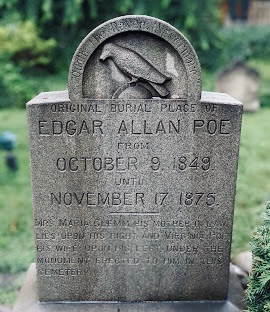


Poe’s Headstone placed where he was originally buried - Westminster Presbyterian Church


The Poe Monument where Edgar Allan Poe and his wife Virginia are now buried
The “Poe Toaster” is another intriguing story about Edgar Poe. Starting around 1949, an anonymous person, dressed in black with a scarf and hat, would arrive at Poe's grave, every early morning of January 19th, (Poe's birthday) leaving three roses and a partial bottle of cognac as a tribute. The Toaster would pour a glass of cognac, raise a toast, and leave the unfinished bottle, along with the three red roses at the grave. The identity of the Toaster was never known, and the reason for the cognac and roses were also never known. In 2009 the Poe Toaster tradition ended as the Toaster never appeared again. Another Edgar Allen Poe mystery.


The Poe Toaster & the Site where Edgar Allan died
Our last stop in Baltimore Maryland, before we depart for Delaware is the quirky diner called Paper Moon. This diner is full of odd and fun displays. There are adorned mannequins everywhere outside and inside - some are dressed, some are not. Just inside the door, there is a female mannequin head with a coiffure entirely made of plastic toy soldiers — Guy’s favorite display. Some mannequins have pennies glued all over their bodies, some have buttons glued on them, some only have legs or partial body parts, and some are outside lounging seductively on a cow. There are displays of doll heads, rows of toy cars on bathroom ceilings, a huge Pez dispenser collection, and plastic toys glued and hanging everywhere. Inside, the diner is packed with people, it is loud, the vibe is fun, and the food was delicious.


Paper Moon Cafe
A few interesting tidbits worth mentioning about Delaware. Delaware was the first established state of the United States. It is the second smallest of the states and is the least populated. Amazingly though, almost 67.8% of Fortune 500 companies are located in this small state. And, there are more corporate entities formed in Delaware than residents. For us, we came to Delaware for other reasons. One was to visit Wilmington where Bob Marley resided off and on over the period of his life between 1965 to 1977. His mother, Cedella met Edward Booker who lived in Wilmington in 1955, when she was visiting her sister there. She eventually married Edward and moved to North Wilmington in the early 1960s. Bob stayed behind in Kingston, Jamaica, and formed his Reggae group the Wailers. His music career was starting but they were not making a huge amount of money so Bob joined his mother in Wilmington working odd jobs including a cleaner at the DuPont Hotel, a lab assistant at the DuPont Experimental Plant, and a forklift operator at the Chrysler plant under the name “Donald Marley” - all to support his music career. Bob did return to Jamaica with an electric guitar and the money he saved and started his record label Wail 'N Soul 'M that would eventually become Tuff Gong International. Over the years he did continue to visit Wilmington with his wife Rita and they eventually bought a house next to his mothers on Tatnall street. His son Stephen was born there and a few of his other children grew up there as well. In 2015, the playground across the street from Bob and his mothers former homes was renovated and renamed “One Love Park” after one of Marley’s most famous songs “One Love / People Get Ready”. Just across the park there is a home with Bob Marleys portrait painted on it that also sells hats. An interesting stop in a nevertheless dodgy part of town.


Bob Marley’s previous home - One Love Park - Wilmington Delaware
The state of Delaware although small is encased in history galore. Our time here has been short as we are making our way back to Canada with travel time constraints. We did manage to camp a few nights at the Cape Henlope State Park just outside the city of Lewes. The beaches were beautiful looking out towards the Atlantic Ocean. We did a few hikes in the park and at the beach where we discovered cacti in Delaware - who knew? The winds were chilly and we wrapped ourselves up in our winter jackets. A stark reality from our recent time spent in sunny hot Florida. I guess we are getting prepared for our reentry back into Canada. Near the campsite is the Fort Miles Historic site with observation towers that were built to protect the shores during World War II. There are also bunkers, and a whole lot of military cannon artilleries of all sizes. This made for interesting and scenic hikes in the park.


Cape Henlope State Park
Last thing to see here in Lewes Delaware is the Zwaanendael Museum. This museum sits in a small park area with beautiful old buildings and tulips blooming everywhere - we were told it was the beginning of the Tulip Festival here. The museum was built to honour the 300th anniversary of Delaware's first European settlement - Zwaanendael a Dutch colony which was founded here in 1631. The museum was built to resemble the City Hall in Hoorn in Netherlands. The museum is small but has many interesting displays and stories. One of which is artifacts recovered from the shipwreck of the DeBraak. The DeBraak was a single-masted “cutter,” built in Holland in 1781 and served the Dutch for 14 years. The DeBraak was in an English port when war broke out between the two countries and the British navy seized The DeBraak. The British navy did a complete overhaul to it. They added a second mast and installed more guns. In 1798, the DeBraak with James Drew as her captain was ordered to sail across the Atlantic as an armed guard for a convoy of merchant ships, which in those days were always at risk from pirates. Early into the journey James’ crew sailed the DeBraak away from the convoy, presumably in search of some Spanish treasure. For 10 weeks, the DeBraak was nowhere to be seen. When she finally re-emerged to meet up with the convoy at Cape Henlopen, James Drew did have his Spanish treasure. On May 25, Captain Drew was below deck celebrating his new found treasure and had had a bit too much to drink according to local pilot Andrew Allen. Andrew noticed dark clouds on the horizon and told the crew to take down some of the DeBraak’s sails as a precaution. When captain Drew reappeared on deck, he became angry that someone else was ordering his men about so he ordered the sails back up. The storm arrived and knocked the DeBraak over on her side and she sunk within minutes. Andrew Allen was among the thirty some survivors while Captain Drew and 46 others lost their lives.
The museum also has a small collection of Delftware, a tin-glazed earthenware made in Delftware Holland starting in the 17th century and mostly blue and whites, and also local history of Lewes.


Zwaanendael Museum
A bit out of place at this museum, and on the quirkier side of things, was the “The Fiji Merman”(Ningyo), a male mermaid. In Japanese folklore ningyo means human fish, and refers to this creature which is similar to a mermaid or mermen (half-human, half-fish) and not necessarily an attractive one. Over time the meaning of the Ningyo has changed and may be a sign of good luck, bad luck, or even a symbol of longevity. The Ningyo has been a part of the Japanese culture since the 7th century and mostly unknown to the rest of the world. During Sakoku - which means "country in chains," the isolationist policy of the Tokugawa Shogunate in Japan from 1603-1867 limited Japan in trade and interaction with foreign countries. In 1854 at the Convention of Kanagawa, the United States and the Tokugawa Shogunate signed a treaty that opened the Japanese ports to trade with the United States and other countries. Because of this, interest in Japanese culture grew and created an increase of Japanese-inspired objects made specifically for Western consumers such as the Ningyo. It is believed this figurine was made by the Japanese from natural and man-made materials to sell to Western merchants. At the beginning of the twentieth century, a visiting sea captain gave the “The Fiji Merman” to Sarah Martin's family of Lewes, Delaware. The figurine changed hands a few times until in 1978 when Ella Carpenter took ownership and loaned it to the museum. After her passing in 1985, her possessions, including this object, went to auction. That same year Lewes community members came together under the group name, "Friends of the Merman Society" to purchase and donate the object to the Zwaanendael Museum, where it is now on display.


The Fiji Merman
Small hiccups of the road. As we were leaving the Cape Henlope State Park campground, Roadies “check tire pressure” light came on and we soon discovered a slow leak in the back tire due to a screw stuck in it. We ended up getting the runaround and going to a few different tire places in Lewes before we were able to get it all fixed for $15. Luckily for us it had not yet gone completely flat and we were still able to drive there. The everyday challenges of being on the road. Sometimes it’s a mouse hitchhiker, sometimes it’s a screw hitching a ride by piercing its way into a tire. Hopefully, there will be no more to come.


Another Roadie “issue” - not the tire. Nurse Guy is on call 24/7
The wild horses of Assateague Island in Maryland. They are majestic and mysterious animals who quietly roamed the forest and sea side, and even came through our campsite grazing and laying around. We humans respectively surround them from a safe distance with our cameras, in awe, but the beautiful horses gently ignore us, it seems, as if we were not even there.


Wild horses in our campsite
The history of these wild horses of Assateague Island dates back to the 1600s and they have continued to live here for over 300 years. There are two main theories about how the horses arrived on Assateague Island. One is that settlers brought horses to the island to graze to avoid taxation and fencing laws. The horses were then left to roam free, eventually becoming wild. The second theory is a Spanish galleon carrying horses wrecked off the coast, and the surviving horses swam ashore and established a new home on the island. What ever might be the story, these horses have adapted to their new environment quite well. They are stocky and rugged looking and based on their size look more like ponies then full grown horses. Because the grasses they eat are coated with sea salt and their diet has a very rich in salt content, they drink more water than regular horses and as a result have a bloated look. It is estimated that there are between 80 to 100 horses roaming freely here. The park has tried to maintain the horses wildness by having them have as little human contact as possible. When in the park you must stay at least 40 feet away from them at all times and the speed limit in the park is a strict 15 to 25 mph. The park wardens have little interaction with the horses and when they do it is for emergency medical reasons only. In order to keep the herds healthy on the island, the state park controls the mating and pregnancies. A non-hormonal vaccine was developed that is shot via a dart into the hind quarters of selected females, this is to prevent pregnancies. In order to preserve the gene pool each mare is allowed to have at least one foal.


Wild Horses of Assateague Island
We did a few different trail walks on the island. The diversity of this landscape is quite amazing from long stretches of white sand beaches and sand dunes carved by the wind, to forest with pine trees deformed by the harsh weather conditions. Many small deer, ducks, and many other kinds of birds, and of course the horses have made this island their home. In all areas there are telltale signs of wild horses. They can sometimes be sighted and other times just trails where they have traveled. And other times just the remnants of previous visits - nice way to say piles of “horse poop everywhere”. Along one of our walks, we discovered the Baltimore Boulevard or should we say what remains of it today. The Baltimore Boulevard was a 15 mile stretch of road built in the 1950s. It was, at the time, the only paved road on the island and extended south to the Maryland / Virginia State border. The construction plans had been to have streets built that would connect thousands of building lots. These were never built because a storm in 1962 damaged the boulevard, the development was halted and eventually abandoned. And, in 1965 Assateague Island became a national seashore and maintained its beautiful wilderness. According to the park keepers, the Baltimore Boulevard is now mainly used by seagulls to break their shell food by dropping them from the sky. A visit to the Assateague Island was high on our list and despite the rain and cold wind we were not in any way disappointed. Plus, this is where I celebrated my birthday.


The diversity of Assateague Island


Baltimore Boulevard


Wild Horses of Assateague the best birthday gift !
The Mermaid Museum in Berlin Maryland is just outside the Assateague Island where we were camping. I entered the museum by walking up a long decorated staircase. The museum is small and all the exhibits are displayed in one room. There was classical musical playing overhead and the feeling I got in here was whimsical with a touch of magic and a sprinkle or two of the sensuality and erotica. Some displays are, to say the least, questionable like the Hybrid Sea Creature (A Toothed Clam supposedly to compare its human like parts to that of the mermaid), the ”Worlds Smallest Mermaid” (which is preserved in a small bottle of resin), and one of the Mermaid Pets the “Ratfish”. Some exhibits have a bit of humour, like the Cheeto shaped like a mermaid, and an oyster shell. There is a bathtub prop with a mermaid tails and other costume pieces for visitors to dress up into a mermaid and get their picture taken. There are beautiful paintings on display, and a mixture of myth, legends and historical information whether factual or not, I myself found all this quite interesting.


Mermaid Museum
The Jenny Haniver is a mummified creature that is said to be the first real evidence of the existence of mermaids. It has somewhat of a human face and human-like body form. It is actually the carcass of a ray or a skate, a flat cartilaginous fish that has been modified by hand then dried, resulting in this mummified specimen. The first recorded Jenny Haniver dates back to 1558.


Jenny Haniver
And of course what mermaid museum would be complete without The Figi Mermaid. Japanese Fishermen made these from the head of a monkey and the body of a fish. The story here is that Captain Samuel Barrett Eades bought this Fiji Mermaid for approximately 1,200 pounds. In 1822 he began to display this to crowds of people for 1 shilling admission. That same year Captain Eades and his Fiji Mermaid mysteriously disappeared for 17 years. In 1842 Captain Eades was found dead, alone, and poor with his Fiji Mermaid. His son inherited the mermaid and later sold it to the Boston Museum. Eventually it ended up with P.T. Barnum who leased it from the Boston Museum for his museum.


P.T. Barnum & the Fiji Mermaid
There were some interesting diagrams of Ancient Mermaids. The EA was the earliest combination of human and fish dating back at least 4,000 years, this ancient Babylonian Sea God had a human male torso with the tail of a fish. The Atargatis was the fertility goddess who threw herself into a lake after accidentally killing her mortal lover. She took the form of a fish from the waist down as the waters could not totally conceal her divine beauty. And another is Oannes which is also a male torso with a fish tail and is believed to have brought the knowledge of science, the arts, and writing to mankind.


EA - Atargatis - Oannes
Many different cultures have their own beliefs of mermaids. As previously mentioned, in Japan there is the Ningyo which means “Human Fish”. The Japanese believe if you catch a Ningyo it will bring bad luck or good luck. In Africa the Miami Wata which means “Mother Water”, is often depicted with a mirror in her hand which represents movement between the past and the present. In Norway they are called Finfolk. Finfolk are considered nomads who can alternate between living on land and the sea. They abduct humans to be their spouses.


Japanese Ningyo - African Miami Wata -Norwegian Finfolk
Also at the museum is the “Bad luck Banana”. This tidbit is not necessarily mermaid related but still about the sea and is just an interesting story. Sailors in the past and some commercial fisherman even today consider bananas to be bad luck. This is because spiders, snakes, and other vermin’s live among and feed on bananas. These pests would then go on infesting other parts of the ships. Moreover, as bananas ripen they emit an ethylene gas that causes other fruits to spoil more quickly hence they would loose a lot of their cargo because of bananas on board the ship.


Bad Luck Banana & more Mermaid Museum displays
After the calm, peace and nature of Assateague Island and the small towns of Maryland and Delaware we decided to venture for a few hours to Washington D.C to see a few sights. The traffic was hectic and there were people everywhere but we did manage to catch views of the White House, the Washington Monument, the Dwight D. Eisenhower Office Building, and the United States Capitol Building. We did encounter a hyperactive policeman on our way to the United States Capitol Building. As we were driving down the road in the Roadtrek the policeman jumped into the middle of the road directing us this way and that way, eventually he made us turn down another street but let all the other cars go through. We decided to turn around thinking whatever caused the commotion may have ended and continue our drive to the United States Capitol Building. But as soon as we were back at the intersection in question, the same policeman jumped into his car sirens blaring and blocked our way. He then jumped out of his car waving his hands at us yelling ”what the …”. So we quietly turned and drove away and ended up parking behind the United States Capitol Building so we did get to see it eventually. We are both so confused as to why we were not allowed to drive through on that street, but we figured we were better off in the dark than trying to approach the policeman and ask him. After this little “incident” we did eventually depart Washington D.C. without being arrested. Travelling it seems “is ‘often’ like a box of chocolates...”.


Our quick visit to Washington D.C.
As automobile travel began to increase during the 1920s and 1930s a new style of architecture was developing called “Programmatic Architecture”, (functional buildings shaped like other objects for advertising purposes). We made a few quick stops along our way north to check out a couple of these odd architectural style buildings. The first was The Haines Shoe House in Yorklyn PA. This house is shaped like a Work Boot. It was built in 1949 for a grand cost of $26,000. The exterior is stucco with a wood interior frame. It was built to be a guest house for local promotions for Mahlon Haines known as “The Shoe Wizard” to promote his stores. The house is 48 feet long, 25 feet high and 17 feet wide. It is approximately 1,500 square feet and has 3 bedrooms, 2.5 bathrooms, a living room, kitchen / dinette, and recreation room. Today, it can still be rented as a vacation house.


The Haines Shoe House
The second quick stop was a visit to The Coffee Pot in Bedford PA, another example of "Programmatic Architecture". In 1927, Bert Koontz built the 18 foot high Coffee Pot to attract visitors to his lunch cafe which had an adjoining gas station. In 1937 it was converted to a bar with a hotel built behind. It became a regular stop for Greyhound Bus passengers. The Coffee Pot was bought, restored, and moved to its current location in 2004 by the Lincoln Highway Heritage Corridor.


The Coffee Pot
On a personal note, I have always been intrigued and somewhat awed by the Amish culture. I find their tight family and community values intriguing. Here is a small story worthy of being told. We had stopped for the night at a Cracker Barrel, which we often do. Guy and I were ending our day with a glass of wine and chatting in the front seats. Since my seat gets turned around at the end of the day to give us a bit more of a spacious feel, I can’t see what goes on in front of the Roadtrek. After a bit of a pause in our conversation, Guy tells me that at least 12 Amish people (adults and children) had just come out of the Cracker Barrel restaurant and piled into a white van in the parking lot and quietly drove off. When I turned around to see, they were already gone. Now Guy has on many occasions interrupted our conversations to point out a bird or a squirrel but on this occasion when a van load of Amish people loads up and drives by, he fails to interrupt the conversation so I can have a look. He said he was being polite and did not want to interrupt me…. Sadly, as we were limited with time returning to Canada, we were not able to stop in Lancaster Pennsylvania to visit The Amish Village. A detour to Lancaster would have been too far so we decided against it. Maybe another time…. Gotta love my husband.


No pictures of Amish so pretty flowers instead
We made a somber stop in Stoystown Pennsylvania to visit the Flight 93 National Memorial. This is the site where on September 11, 2001 the plane crashed upside-down at 563 miles per hour into a farmer’s field. All 33 passengers, 7 crew members, and the 4 hijackers were killed. Before the crash, some passengers had managed to call their families and friends and had been made aware that two planes had already crashed into the World Trade Towers in New York and one more into the Pentagon. The passengers then realized they were heading straight for the White House in Washington DC, which was only a 20 minute flight away. They then decided to overtake the hijackers in order to save other people’s lives. They made the ultimate sacrifice and are considered heroes. The plane crashed into the farmer’s field instead. At the visitor center there are some of the belongings, articles, and fragments of the plane found at the crash site. The largest piece of the plane fuselage found was only twelve feet long, everything else was bits and pieces, fragments. There is a wall with pictures of victims with the stories of their lives, their accomplishments, and their families. Among the items on display is a “Vial of Soil” that was given to each family member of the victims. The small vial contains soil from the crash site. There is also a place where you can pick up a phone and listen to some of the victims as they made phones calls to their loved ones from the plane.


Flight 93 National Memorial
Outside, the buildings are architecturally designed to create a tunnel-like straight line with a viewing deck at the end that lines up directly with the flight path of the plane. At the far end, in the field, there is a large boulder that represents the exact crash site. The memorial plaza near the crash site, has a marble wall with each of the victims names engraved. An interesting photo in the museum shows a bird’s eye view of the crash site from above showing the indentation in the ground made by the plane’s impact, the shape of the cockpit and the two wings are clearly visible after all debris had been removed.


Flight 93 Memorial - Flight Path


Memorial Plaza Marble wall with engraved names of all 40 victims
Just a few miles down the road from the crash memorial, is the Tower of Voices. This is a 93-foot tall wind chime. There are forty tubular chimes representing the passengers and crew members. The tower contains aluminum chimes that create music when the wind blows through the concrete tower. The chimes need at least 12-15 MPH wind speeds to move and make sounds. The winds were favourable and we sat and listened to the sounds for a while. The entire memorial is sad and it is hard not to feel the heaviness and great sorrow for all these lives so unfairly lost. We both felt it was worth the visit as we both lived through September 11, 2001. That date still effects each of our lives in many ways today. It was good to visit and pay our respect.


The Tower of Voices


Another beautiful lunch stop along the way to cheer us up
So now a bit of light hearted fun with a visit to Gobbler’s Knob to visit Phil in Punxsutawney Pennsylvania. Phil is the famous Pennsylvania Groundhog who depending on if he sees his shadow or not, predicts if there will be 6 more weeks of winter or an early spring. It is believed that the start of Groundhog Day began in 1886 when a group of men from Punxsutawney would get together each summer for a groundhog hunt. For a reason no one seems to know why the hunt was replaced with a mid-winter event based on the European celebration of Candlemas Day on February 2nd. This day is considered the midway point between the winter solstice and the spring equinox. So based on the weather conditions of the day this prediction would tell if winter would last or if there would be an early spring, this was helpful for the farmers. And so the first Groundhog Day Ceremony in Punxsutawney took place back on February 2, 1887 at Gobblers Knob. At Gobblers Knob the ceremonial day starts early in the morning with a bonfire and a fireworks show. The Groundhog Club’s Inner Circle; these are the men you see with the hats who have pledged to protect and preserve the legend of Punxsutawney Phil. They are responsible for planning the events for the day and they also feed and care for Phil throughout the year. Each member receives an honorary title such as Storm Chaser, Stump Warden, Big Flake Makers, and The Handler who is the person responsible for holding Punxsutawney Phil in public. There are currently 15 members. After the members trek to Gobblers Knob the president will tap on the door with an acacia wood cane (which has been passed down through the years), they then lift Phil out of his lair and onto the tree stump to determine if he sees his shadow or not. Phils’ accuracy is “supposedly” 100% over the last 120 years. So far, Phil has seen his shadow and predicted 6 more weeks of winter 14 times more often than not for an early spring. There were 9 years in which Phils predictions were not recorded but no one knows the reason why.


Gobbler’s Knob
Phil was named after King Phillip of England and he officially works one day a year, February 2nd, and the other 364 years he spends in a warm terrarium built into the Punxsutawney library. Because of this controlled environment Phil does not actually hibernate like other ground hogs. He is given food and water daily and increases the amount of sleep each day during hibernation season but he does not really hibernate. The glass walls surrounding the terrarium face both inside and the outside so Phil can actually be observed by anyone at all hours of the day. We should actually say, “the Phils”, because when we arrived at the library, we were surprised to find four Phils in the Burrow. Three were snuggled together napping but lucky for us one was out and about enjoying the day. We enjoyed our day in Punxsutawney and took a few pictures with the numerous Groundhog statues spread around the town.


The Phils
A few more facts about Groundhogs. Their front paws only have four toes and their back paws have five. They have two teeth on top and two on the bottom but they over lap. There eyes are set on the sides of their heads which gives them an almost 300-degree range of vision. They give birth between four to five babies each spring. Groundhogs are very clean animals, they have a “bathroom” chamber in their burrow which is separate from where they sleep.


A few more Phils in Punxsutawney
The PennDOT Road Sign Sculpture Garden in Meadville Pennsylvania was a fun stop along the way. For about a quarter mile along the side of the road is a mural wall made of repurposed road signs. Worth the “STOP”. It is located on the property of the Pennsylvania Department of Transportation building and that is why it is called “PennDOT”. This beautiful mural was created by art students from the nearby Allegheny College who teamed up with the DOT employees who had a few extra road signs. There are ocean waves made of blue hospital signs, a barn constructed from red stop signs, many buildings, rainbows, and hot air balloons. Unfortunately, the day was rainy and there really was no safe place to stop and closely admire this art piece but still, we did manage to get a few photos. Just down the street from the wall there was another similar art display, a garden of flowers also made from repurposed road signs.


PennDOT Road Sign Sculpture Garden & Flowers
What a great way to end our travels in the United States, with a visit to Buffalo New York to see my sister Michelle and her family. Together we visited the Buffalo Science Museum and the Botanical Gardens. We started a World War playing Risk, ate lots of delicious foods, drank good wine, and shared many, many laughs. On our last day we all drove to the Niagara Falls on the US side. This is where we parted and said our goodbyes, making more memories to cherish.


Time spent with family in Buffalo
So for now we bid farewell to the US of A. We thank you for all you had to offer. We thoroughly enjoyed our time here. We are reentering Canada today. Hopefully the Canadian weather will behave for us for the next 6 months until we return for more good times in the USA.




Comments