Blog #11. Bayous, Oak trees, Crawfish, Alligators and the occasional Snowstorm
- Pamela Sonier
- Feb 3, 2025
- 32 min read

Updated: May 24, 2025
Well it’s mid January and unexpectedly we find ourselves still in Texas. For almost 3 weeks we waited out the cold weather - on hold waiting - craving movement. Finally, today, we’re back on the road and on our way east to Louisiana. Excited to be back on the road we drove the entire day - even waited out a traffic jam of nearly 2 hours just before finally crossing the Texas / Louisiana border. We are overjoyed to be on the road and driving onwards to our next new adventures….


Welcome to Louisiana
First stop is DeRidder Louisiana and a tour of the Gothic Jail, or Hanging Jail as it is also known. This jail along with the courthouse beside it were built and completed in 1914 and opened in 1915. At the time, the Gothic Jail was the only penal institution in the United States built in the "Collegiate Gothic" design (an architectural design popular with colleges and universities). The building is of reinforced concrete and the walls are 13 to 21 inches thick. At the time the jail was built it made history; not only because of its gothic design with its spiral staircase, but also because each jail cell had a toilet, sink, shower, and a window, quite a luxury for prisoners in those days. Most neighbouring houses did not even have indoor plumbing at that time. There was an underground tunnel built that connected the jail directly to the courthouse so when the prisoners went to court they had no interaction with the public and they would quietly enter the courthouse. Originally the jail had 9 cells built to house 13 prisoners but over time things changed and the jail eventually was packed with up to 50 prisoners.


Prisoner #1 - Outside the Gothic Jail - Prisoner # 2
The main level of the jail was for the jailer and his family to live in. There was also the laundry and kitchen on this level and the City Cell (Drunk Cell) which could hold up to 12 prisoners. The second level was made up of a women’s cell area and two general public cell areas which could hold up to 12 prisoners each and the solitary confinement cells for 2 prisoners. The third level held Trustees and 4 prisoners per cell. (We were not allowed on the third level due to the railing height as it was considered unsafe).


Rooms the jailer & his family occupied


Prisoner Cells


Prisoner Isolation Cells


Images inside the Gothic Jail - Tunnel to the courthouse
As previously mentioned this jail was also known as “the Hanging Jail”. Two prisoners Milton Brasseaux and Joe Genna had lured a local taxi driver J.J. Brevelle to a remote area where they beat and murdered him to steal $14.00 and his taxi. When they were caught, they were to be made an example of. They were hung in the spiral staircase of the jail witnessed by other prisoners, on March 9, 1928.


Mug Shots - Hanging Noose - Spiral Staircase
There are also rumours of haunted cells and ghosts of the jailers. Our tour guide said she has felt these spirits and swears they are friendly and at times a bit mischievous. Back in the 70’s freelance photographer Christine Smith took a job to photograph the jail. She felt the view from above would be best so she hired a cherry picker and took her photos. Later when she looked at her negatives she discovered the image of a person in the bottom left corner of one of them. It is believed this image is of one of the jailers as this is where he would stand each morning drinking his coffee, smoking his pipe wearing a white bibbed shirt and overalls, and this is what the image portrayed. There were still prisoners locked inside the jail when the building was added to the National Register of Historic Places and the jail finally closed in 1984.


Former deputies - Image of jail from above check out the bottom left window
Did you know that the first capital of Texas was actually established in Louisiana not Texas. History comes up with some interesting stories. Back in 1717 after establishing Natchitoches, St. Denis (a French-Canadian soldier and explorer who helped develop Louisiana (New France and Spanish Texas areas) led a band of missionaries and Spanish soldiers to a site twelve miles from the French post. Their purpose was to start trade with the Spanish and to fix the border between Mexico and Louisiana. In 1721 a better fort was built at the site and was called Los Adaes by the Spanish, and this site became the first capital of Texas and would remain the capital for 50 years. Robeline itself was not established until 1881 when the railroad came through. The village was originally name “Leolia” after the postmaster’s daughter. Later, it was renamed Robeline after an earlier settler. Los Adaes State Historical Park in Robeline has maintained the site and there is a historical marker to indicate the area. It made for an interesting stop and a great spot to stop for lunch.


Robeline Louisiana
We travelled north in Louisiana to Shreveport to see a few of those usual things we love to discover. First was a giant 8 foot rooster hanging out in a vacant lot. The rooster was put there by Jack Lamb, he owned the lot and for years and would just sit in his parked car and watch as people came to visit his rooster. Just a couple blocks away is a 19 foot tall Dalmatian dog statue with 254 blinking lights that performs a light show after dark. Also nearby, on Elvis Presley Avenue, is a Rockin statue of Elvis Presley, he preformed at the Shreveport Municipal Memorial Auditorium for the local radio station program Hayride Louisiana and that performance was considered his first big break.


Shreveport Louisiana
Last but not least in Shreveport is the Once in a Millennium Moon Mural. This mural comes with an amazing story behind it. This is one of the largest publicly funded murals in the USA and it covers 30,000 square feet, and is 14 stories tall. It is painted on an AT&T building in downtown Shreveport. Interestingly enough, the day we arrived we met a young man there named Marcel. He is originally from Mississippi and had moved to Shreveport 10 years ago with his family. He said when he looked out of his office window this mural would catch his eye and that day he had finally decided to come and see it. Like us, he was quite enthralled with the mural. Leading up to the Y2K when the date was to turn to 2000 from 1999 and many people felt the world would end or at least wreck havoc on the computer systems, this mural was to be a “Love Letter “ to the city and its residents. In 1999 Meg Saligman a muralist from Philadelphia was commissioned to create this mural. She began researching the city and interviewing and taking photos of hundreds of residents. She then asked them what objects they would like to give the people in Shreveport at the turn of the next millennium and why, she also asked them what was the most beautiful thing they had ever seen and how it felt to live in Shreveport. The mural was created with the help of 4,000 community collaborators and 1,500 gallons of donated paint. Seligman had developed a paint-by-number grid system specifically for this mural and this system would later became an industry standard. The mural has 19 residents from the city either holding or posing alongside their items which are either a family heirloom or something personal. Beside the mural is a numbered guide that explains the names and meanings of each person and the objects. Beautiful scene.


Once in a Millennium Moon Mural
Next we headed east to Gibsland, to the Bonnie & Clyde Ambush Museum. The museum is in the building that used to be the Ma Canfield's Cafe which was the last place Bonnie & Clyde visited. They bought two sandwiches for takeout, then drove down the road 8 miles where they were ambushed and killed. The museum has quite a collection of interesting items. There is the stool that was in the cafe that Clyde had sat on waiting for his sandwich, some of the guns and rifles both Bonnie and Clyde used, a note Bonnie had written to her mom, a letter Clyde had written to Henry Ford about how much he liked the eight cylinder engine, a fur coat Bonnie wore, an interesting replica of the “Death Car”, numerous photos and information about the infamous duo and a mold of Clyde’s hand. Now Clydes hand has a bit of an interesting story to it. When Bonnie and Clyde were killed, the local undertaker made a plaster cast of Clyde's right hand. The reporter who photographed the corpses took the hand home, but his wife did not want it in the house, so he gave it to his brother. When his son was going through his father's possessions with Perry Carver the proprietor of the museum, they came across a small box labeled Clyde's Hand." The hand is now on display.


Bonnie & Clyde Ambush Museum


Mold of Clyde Barrow’s hand


Letter Clyde wrote to Henry Ford & Letter Bonnie wrote to her mother
After the museum, we drove the 8 miles down the road to the site of the ambush where six police officers, who had been chasing the elusive couple across the country for approximalty 14 months, were in hiding waiting for the duo to arrive. There was over 130 shots fired at the car. They obviously wanted to make sure they were dead. The site is very quiet and there is a monument on the side of the road that marks where the car was ambushed.


Bonnie & Clyde Ambush Site


The officers who captured Bonnie & Clyde - Bonnie & Clydes car after ambush
Also in Gibsland is, what’s left of it anyways, a delapitated gas station that has a yellow plaque marking the spot where the pay phone was located that was used by Texas Ranger Frank Hamer to call his bosses in Dallas to let them know of Bonnie and Clyde's deaths.


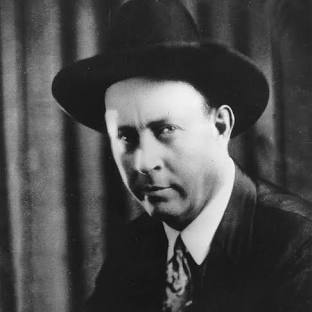
Gas station where Texas Ranger Frank Hamer made the call
We continued our travels east to the Poverty Point World Heritage Site. This site was built by American Indians 3,500 years ago. The site’s name comes from the “Poverty Point” plantation that was located in the area. The site is made up of a huge earthen complex with six hand made earth mounds of different heights, six concentric C-shaped ridges, and a plaza. Based on the size and complexity of this site and the artifacts that have been discovered here, the people here were settled, which was unusual as they were hunter-gatherers who did not grow and harvest. The design of Poverty Point has not been found anywhere else and it has the largest earthworks in the Western Hemisphere. It has been estimated that the landscape preparation and construction of the mounds may have required moving as much as 53 million cubic feet of soil. This is quite the feat as a cubic foot of soil weighs 75 -100 pounds, and the labourers carried this dirt in roughly 50-pound baskets, one basket at the time. Soil was borrowed from different areas and carried in baskets to the different mounds sites. The purpose of these mounds is not yet understood. The six concentric elevations are where the homes were built.


Poverty Point
We did the 4km hiking tour around the site and we were able to climb the stairs up to the top of Mound A, the largest mound which is about 72 feet above the surrounding land surface. At its base, the mound measures about 710 feet in length (east to west) and 660 feet in width (north to south). The site itself is really fascinating. The guide at the information center told us that only 1% of the site has been excavated so far. The size of the area is quite mind boggling. We were told that no bones or teeth were found. This, according to the guide, is an indication the people cared for the dead. The deceased had either a water or a sky burial; meaning they were either buried in the water or left in the open for animals to feed on. After this many years, bones were possibly taken away by animals and eaten or had broken down and dissipated from exposure.


Hiking to the top of Mound A at Poverty Point
So far, driving in Louisiana has been quite different from Texas with its flat bare land, winds, and rolling tumbleweeds. Louisiana has much more greenery. It has magnificent giant oak and pine trees, sugarcane fields, small bayous tucked away off the side of the road, and very little to no wind at all, which is a pleasant relief from that persistent Texan wind. One of our favorite saying in Texas was “the weather wouldn’t be too bad if not for the wind”. In Louisiana, so it seems, the winds are much more tame.


Louisiana highway scenery
Ville Platte is where the Swamp Pop Museum is located. We were looking forward to visiting this museum and area as this is where the French-Louisiana Swamp Pop music was born. In the early 1950’s many musicians swapped their accordions and fiddles for guitars, saxophones, and pianos, and started playing a combination of Rock in Roll and Rhythm & Blues blending in their own Cajun and Creole styles. At first this music genre was called “South Louisiana Music” and later became known as Swamp Pop. Interestingly the name “Swamp Pop” was created in England in the early 1970’s by music writer Bill Millar. Some of Swamp Pop hits include Sea of Love by Phil Phillips, Wasted Days & Wasted Nights by Freddy Fender, and See You Later Alligator by Bobby Charles.


Swamp Pop Museum
The guide at the museum was full of interesting stories about the origin and history of the music. She grew up in Ville Platte and her family and extended family are made up of many Swamp Pop musicians. On display in the museum is her uncle’s Keyboard. There is also jackets and other clothing some of the musicians wore, original handwritten lyrics by Phil Phillips for Sea of Love, a handheld original transistor radio and of course numerous records and photos of musicians.


Swamp Pop Museum
There were many clubs in the area that would play the Swamp Pop music and the local people would attend these clubs to dance and listen to the music. The Evangeline Club for one, was a famous here in Ville Platte and the museum has the Club’s original piano that Fats Domino actually played on. There is a pair of Saddle Oxford Shoes that were donated to the museum by Linda Hayden. The shoes still have the original tape on the bottom. The tape was used so when the ladies danced they could spin and swirl their skirts as the shoes had no grips.


Swamp Pop Museum
The peak years for Swamp Pop Music was between 1958 to 1964, but it started to decline when the Beatles played on the Ed Sullivan Show in 1964. Other factors the led to its decline were the popularity of Rock n Roll and many of the musicians wanted to settle down and start families. Nowadays the Swamp Pop musicians perform on special occasions, reunions, fund raisers, and festivals. In 1995 Louisiana designated Ville Platte “The Swamp Pop Capital of the World”.


Swamp Pop Museum
The next morning we woke up early and very excited about our next venture. Today, at 9 am, we are going to the famous Fred’s Lounge, in Mamou Louisiana the Cajun Music Capital of the World. Fred's Lounge is known for its Cajun music, dancing, and also for reviving the “Courir de Mardi Gras” tradition. After the end of World War II the Cajun culture started fading in some of the communities in south central Louisiana. The French language was being discouraged and many Big Bands were taking over from the local Cajun musicians. When French speaking Alfred “Fred” Tate returned from the war, he purchased the red brick bar on Main Street and in 1950 reignited the Courir de Mardi Gras tradition also called "Fat Tuesday Run”. This traditional run refers to a Cajun Mardi Gras celebration where people dress in costumes and usually on horseback go house to house "begging" for ingredients to make a communal gumbo, with the highlight being the chase and capture of a chicken.
In 1962, live Radio Broadcasts began every Saturday morning at Fred’s lounge, and still goes on today. Originally these broadcasts were done in Louisiana French to honour the Acadian roots with the announcer introducing the bands and reading out commercials. Today the broadcast and music is half in English and half in Cajun French. Every Saturday the lounge opens at 8am and between 9am to 2pm there is a live band playing Cajun music: fiddle, guitar, accordion, drum, and lively voices. The town councilman, while sitting on the same stage with the band, starts broadcasting on the local AM and FM radio stations. The place is packed with everyone is dancing, drinking beers, liquor, and “Fred’s Omelet” which is a Bloody Mary in a plastic cup. Quite a spectacle to partake in. While we sat enjoying the entertainment, we glanced at some pictures on the wall-of-fame of musicians who have played here over the years, and low and behold we find a picture of a Johnny Sonnier - Guy’s family name - I am sure he is related to Guy somehow. Fun times, drinking beer at 9 o’clock in the morning and grooving to some Cajun entertainment.


Just a normal Saturday morning at Fred’s Lounge, loving it.
We did a quick stop in Rayne on our way to New Orleans. This is the Frog Capital of the World. There are numerous Frog statues throughout the town painted in different themes. Reminds us a bit of Hutto Texas with all the hippos. Back in the 1880’s Frenchman Doant Pucheu came to Louisiana first selling ducks and then frog legs in New Orleans. For awhile the business was extremely successful, selling frog legs all over the world and Rayne was the center of the Louisiana frog industry. The Louisiana Frog Company Plant was the largest shipper of edible frogs in the world. In 1937 over 500,000 frogs were shipped. By the 1970’s the frog leg industry began to experience a sharp decline. So, in 1973, Rayne threw its first Frog Festival and has continued the tradition ever since. Teenagers are elected to represent their hometown and compete not based on beauty, but rather knowledge of their town’s history. There is lots of kissing live frogs and many people bring live frogs dressed up in costumes. There are even frog leg snacks available. We thought of trying frog legs while we were there but we are done with deep fry for now.


It’s Raining Frogs !!!
Due to the winter weather expected in South East United States over the next week we decided to head to New Orleans to spend a few days and wait out the weather before continuing and travel the rest of Louisiana. We stayed at a campsite located only about a 15 minute drive from the French Quarter in New Orleans. The campsite had full hookups so we had water, heat, sewer, and even a shuttle to the French Quarter for a small fee. Even had a mascot chicken wondering around the campground.


Campsite in New Orleans with the neighbourhood chicken
We did take advantage of the shuttle and ventured to explore a bit of New Orleans. We had traveled here about 11 years ago for one week, so we wanted to see how different things looked. We walked around the French Quarter. As we turned off Canal Street on to Bourbon Street we were met with a large somber memorial of pictures, candles, flowers, beads, and stuffed toys in memory of the victims of the horrific New Years incident that had happened here recently. At 03:15am on Wednesday January 1st, 2025 a vehicle passed a police blockade and sped down Bourbon Street killing 14 people and injuring 35 people as they were celebrating New Years Eve. The driver died in a shootout with police and the FBI have called this an act of terrorism. Sometimes the world we live in can become so sad and so very hard to understand. We chose not to take any photos of the memorial as it seemed like the right thing to do.


Strolling in the French Quarter
Bourbon Street hasn’t changed. It is still full of people - some more drunk than others, bars, restaurants, and street performers on almost every corner. The air smells like stale beer and a strong aroma of marijuana lingers everywhere. The sounds of people laughing, partying, and music escaping from small venues overwhelmed our ears almost immediately. We did venture to Jackson Square which was full of independent artists showing their displays, horse carriages offering rides, shops selling famous pecan pralines, T-shirts, and of the course the famous Cafe Du Monde where we stopped for hot chocolate and beignet. We were looking forward to the beignet as from our previous trip here we found it delicious, this time though not so much. I guess as we get older fried dough and icing sugar is not quite as tantalizing to our taste buds as it was in our youth, 11 years ago.


Cafe Du Monde
We walked to the Treme neighbourhood (the formal name is Faubourg Treme) in New Orleans. As most of you know we have our beautiful dog whom we named Treme after visiting here the first time. The history of the Treme neighbourhood is quite substantial. The Tremé land was originally part of the Morand Plantation, as well as two Forts: St. Ferdinand and St. John. Charles Morand was working for the Company of the Indies and had built the city's first brickyard. Many of these bricks were used to build some of the city's original buildings and streets. Morand bought the land, and turned the brickyard into his plantation home. After his death, his son sold the plantation to the Moreau family in 1774. Claude Tremé was a poor, white hat-maker from France who met Julia Moreau, now some say she was the granddaughter of the original Moreau plantation owners, while others say she was a freed woman, formerly enslaved on their plantation, either way, Julia and Claude fell in love and married. Not long after they got married Claude Tremé took over the deed to the Moreau plantation. He and Julia began dividing up the land and selling off plots, mostly to freed people of colour, African Slaves who had either obtained, bought or bargained for their freedom, and many refugees from Haiti who were fleeing the revolution there. As the United States still had slavery it was quite remarkable that these people were able to own property. The city bought the remaining land for $40,000 in 1810, and the Tremé neighborhood, became an official part of New Orleans in 1812. The Treme neighbourhood is one of the oldest neighbourhoods in New Orleans and is the oldest African American neighbourhood in the United States. In 1966 a huge section of the Treme was demolished to make way for huge cement slabs to support a section of the highway I-10 that now passes overhead. The Treme neighbourhood is rich with history and is considered to be the birthplace of jazz. Walking through the neighbourhood admiring the beautiful old homes, oak trees, and feeling the history around us was quite stimulating.


Strolling in the Treme
We decided to go to the Mardi Gras World in New Orleans as well. This is where they make the floats for the Mardi Gras parade. The site is a bit out of the way and busy near the port where there were 2 cruise ships boarding passengers that day, so there was a bit of chaos for us when we got off the streetcar.


On our way to Mardi Gras World
The tour included a short film that gave some of the history of the Mardi Gras parade. After the film we were served some of the delicious King Cake. Guy stood in line twice and had two pieces. “I’m hungry” he said. The King Cake is a Mardi Gras tradition. It is made in the traditional three colours of Mardi Gras: purple representing justice, green representing faith, and gold representing power. The cake tastes like a light cinnamon roll with icing and it is quite delicious. At a Mardi Gras party, the king cake is served and if your slice contains the small baby, you are declared “king for the day” and based on Mardi Gras custom you must host the next party. Originally, the baby was placed in the cake to symbolize the baby Jesus. After eating our cake we started our tour of the 300,000 square foot warehouse where the floats are constructed.
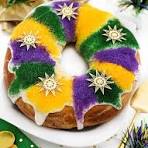
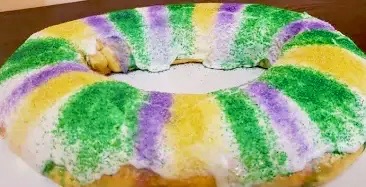

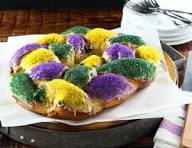
Delicious King Cake
Each year the Mardi Gras parade is restricted to 49 tractors pulling floats through the streets. At one time it would have been one float per tractor but now they add more floats to a tractor so although there is still only 49 tractors, the parade now has many more floats so the parade can last upwards of 8 or 9 hours.


Mardi Gras Parade Floats
The prop structures on the floats are made from fibreglass, metal, wood, and styrofoam sheets glued together or one piece of styrofoam carved. The artists carve in details with a knife and a horse comb. Sandpaper is used to smooth everything out. A layer of papier-mâché is then added and primed, and then the details are painted on. Each float, according to our guide, has a port-a-toilet on board. There are hooks on the float for drunk riders to be secured to prevent them from falling off.


Creative process Mardi Gras World
Each Mardi Gras Parade Krewe has a unique history and theme. Some have been around for decades and others just a few years. Krewes are organizations made up of members who plan and participate in Mardi Gras festivities. There is a fee to join a Krewe and many of the Krewe’s have long wait lists to join. You need to be a member of a Krewe in order to ride in the Mardi Gras Parade. The float riders all wear a mask. This became a tradition because back in the early Carnivals people would put on masks so they could interact with people who were considered ‘outside’ their class and to keep their reputation untarnished. Today float riders are required by law to wear masks to keep with the mystery and tradition, and many Krewes never reveal who their king or queen are. The method of selecting a king varies from krewe to krewe. Some krewes will hold random draws while others will invite a celebrity to be their king. The method for choosing a queen varies from krewe to krewe as well. In all-male krewes, the queen is usually a debutante; however, in all-female krewes, a member is usually crowned as the queen.


Props from Mardi Gras World
Throws, these are the beads, doubloons, cups, and trinkets that Krewe members on the floats throw to the parade watchers along the route. Parade goers yell to the Krewe members “Throw Me Somethin’ Mister”. Up until the 1960s the beads originally were multi-coloured strings of glass beads made in Czechoslovakia. Now they are less expensive plastic beads and some are more elaborate metallic beads with figures of animals and people. Doubloons are large coins made from wood or metal made in the colours of the Mardi Gras and stamped with the parade theme on one side and the krewe's emblem on the other. The Krewe of Zulu are famous for their hand-painted coconuts. The Krewe of Muses is known for their hand-decorated glitter shoes and the Krewe of Tucks is known for throwing coloured toilet paper rolls, soap, and gold painted toilet plungers and brushes just to list a few.


A bit more from Mardi Gras World
As we said, we came straight to New Orleans to hide and wait for the historical winter storm to pass us by. And the snow storm did come, about 8 inches of snow in 15 hours and wind gusts up to 45 kms per hour. The weather was 0 degrees but with the wind chill felt like a biting -10 Celsius. We parked ourselves at the campsite in New Orleans and hibernated as we had decided driving the highways in southern Louisiana in snow and ice is definitely not safe. We understood the severity of this storm when listening to the local radio, most of the highways and bridges were closed and the whole state of Louisiana was in chaos. We were literally stuck, no where to go even if we wanted to. On the upside of all this we did experience, firsthand, a very historic moment in Louisiana.


Louisiana’s Historic snowfall of 2025. Eight inches of snow.
After 5 days of winter craziness, we finally got back on the road. Not all the roads, highways or bridges were opened yet in Louisiana. But with a bit of zig and zagging we avoided road closures and on we went. We decided to make our way to Baton Rouge first with a few stops along the way. First stop, LaPlace which is located in Louisiana’s River Parish. There is a holiday tradition here dating back to when the French-German settlers arrived back in the 1700s called Bonfires on the Levee or Christmas Bonfires. This is when the local people light 20-foot high wooden bonfires atop the Mississippi River on Christmas Eve. There are a few different theories as to what they were originally for some say they were used to guide ships along the rivers, others say they were a way to celebrate the end of harvest season, others believe they were to light the way for people to attend midnight mass, most children believe they were light to guide the way for Papa Noel (Santa Clause) to find all the good children. In 2020 the town built a permanent wooden effigy, a 50 foot wooden alligator named Saint as their mascot in honour of their yearly tradition and also as a way to draw tourists year round. It worked, we came.


LaPlace’s Mascot - Saint
We also stopped to visit the Hansen Museum of Disease in Carville. Hansen’s Disease is also known as Leprosy. This museum is now on a Louisiana National Guard Base so we had to go through a security check and show ID to get in. Photo taking was restricted to only inside the museum and not the outside buildings. This is another museums that exploded our minds with so much information. The name Hansen’s Disease was used to try and avoid the “Stigma” with the name “Leprosy”. Many religions believed that leprosy was “a curse from God” rather than a medical condition. As well, many people feared leprosy based on the inaccurate belief that it was a highly contagious disease. Sometimes family would leave their infected family member at the front gate of the hospital and some patients would go so far as to change their names to hide their family identity. This museum tells the story of these people, the staff that lived there, as well as explanations about the disease, history and the treatments.
In 1894 The Louisiana Leper Home in Carville was formed at an abandoned plantation. Originally the home was for patients from Louisiana only but other states wanted a quarantine location for leprosy patients so the federal government made this the national quarantine hospital. Back in those days people with leprosy were not allowed on public transportations so the first patients arrived on a coal barge that was towed up the Mississippi River. Eventually the Leprosarium (a hospital or facility used to treat people with Leprosy) at Carville would treat people with leprosy from all over the world. The National Leprosy Act of 1917 stated that all people diagnosed with leprosy had to be quarantined here. In 1921 the U.S. Public Health took over the hospital and the last mandatory isolation here was in 1960.


The Louisiana Leper Home
The Leprosarium eventually changed into a home and the people with Leprosy could live out their lives here. Between 1894 to 1999 over 5,000 patients lived at Carville while receiving treatments. Because of the studies and research done at Carville over the decades, as well with the help of patients, doctors, and the Daughters of Charity there is a far greater understanding of leprosy. There is now a multi-drug therapy that some say is a cure for leprosy.



Patients
Dr Hansen was a Norwegian doctor who identified the bacterium Mycobacterium leprae in 1873 as the cause of leprosy. Mycobacterium leprae, is the germ that causes leprosy, it is a bacillus and it is related to tuberculosis (TB) although it is not as contagious as TB and only 5% of the world population can get leprosy. The germ that causes leprosy cannot be cultured in the lab. In 1971 is was discovered that the 9-banded armadillo could be infected with leprosy and the 9-banded armadillo is the only mammal other then humans who can get leprosy. It is estimated that in some areas up to 25% of armadillos carry the leprosy bacteria. Today the armadillo is still being used in research.




Dr Hansen & the 9-banded Armadillos
Dr. Guy H Faget was the Medical Officer in Charge at Carville. He worked at the Leper home from 1940 -1947, his background was in tuberculosis. Dr Faget recognized many similarities between tuberculosis and leprosy. He discovered that research work was being done at the Mayo clinic that had found a sulphone drug Promin was effective for TB in guinea pigs. In 1941 he began using this sulphone drug Promin for treatment of leprosy and the drug was given by intravenous injections to volunteer patients. In the 1950’s after 10 years of this drug treatment many patients were medically discharged and many newly diagnosed patients could receive the treatment from a doctor outside so they did not need to be admitted.


Dr Guy Faget
Daughters of Charity of St Vincent de Paul arrived in 1896 to the home in Carville to care for the patients and they remained until 2005. They were a Catholic order of nursing. Their roles varied from nursing, dietician's, pharmacists, medical record librarians, and medical technologists. They also helped with patient morale, music therapy, theatre, and recreation.


Daughters of Charity of St. Vincent de Paul
An interesting anecdote is that Coca-Cola was not sold in the canteen at Carville as the Louisiana Coca Cola distributor was a leprophobe. Even then, Coca-Cola would occasionally ship a few cases of bottles that were chipped or cracked. They would charge the deposit on the bottles but would not accept the empty bottles back as they feared contamination and felt if the public were aware that they accepted these bottles they would stop buying Coke. Patients started making Coca-Cola Bottle Gardens where they would frame the garden and make shapes with these bottles. Once Pepsi started dealing with the patient canteen and accepting the empty bottles, Coke changed their minds, and many of the patients dug up their old coke bottles to get their refunds. The money the patients used was disinfected with a bi-chloride solution before it left the hospital grounds and the patients mail was sterilized in an oven before being delivered to outside addresses but this eventually ended in the late 1960’s.


Coca-cola gardens


Hansen Museum of Disease
We made it to Baton Rouge the capital of Louisiana. I think one of our main reasons to come here is because we both grew up listening to the song “Me & Bobbi McGee” so it’s been on our radar. We boondocked the night at a casino right along the Mississippi River. We did go to visit the Old State Capital but unfortunately it was closed for renovations. We did go up to the top of the new Louisiana State Capital which is 450 feet tall. Beautiful viewS of Baton Rouge and the entire area. We even saw the casino parking lot we had stayed in the night before. We also saw the Sing the River Sculpture which is a large chrome orb artwork which is suppose to “sing” with the different water levels of the adjacent Mississippi River. The day we visited I guess it was not in the mood to sing because the only sound we could hear was the traffic and sounds of tug boats pushing the river barges.


Baton Rouge
Lafayette is considered the hub of Acadiana, a region of southern Louisiana that was settled by French-speaking Acadians in the 18th century, also known in the region as Cajuns. The Acadian people were exiled from Nova Scotia, where they had lived peacefully for over 150 years under a French authority. They were exiled during the time of war for refusing to pledge an allegiance to the English King. The Acadians were not welcomed by many of the Louisiana French as they spoke a regional French called Acadian. But once they began marrying non-Acadians and their spouses began to speak the Acadian French, eventually their culture evolved. LARC’s Acadian Village is a village that shows how the early French settlers lived. There are many different homes, a school house, a church, a forge, and doctors office to explore. There is definitely a peacefulness in the air here and the village itself it beautiful. It is wonderful to walk among history and imagine a lifetime of before. And, again finding Guy’s family name in the writings.


LARC Acadian Village
Later we decided to boondocked for 2 nights in the Vermilionville Historic Park parking lot while in Lafayette. This park also explores the Acadian History. On our second night here they were offering a free movie called “Dance for a Chicken: The Cajun Mardi Gras”. We went to watch the film as we had learnt about this tradition at Fred’s Lounge in Mamou. Oh my goodness what a movie. There was a total of 6 people viewing. This was filmed around the 1970’s and was difficult to hear and understand at times. Quite frankly the entire thing was a bit morbid, poor chickens. The chicken was thrown in the air and a group of drunken men would start the chase, capturing the chicken by any means necessary. The poor chickens sometimes ended up under a pile of human arms, legs, and bodies….


Vermilionville Historic Park Museum


“Dance for a Chicken: The Cajun Mardi Gras”.
Also in Lafayette is a metal sculpture called Miss Rosie’s Bar: Happy Man. This had originally been made for the 1984 New Orlean’s World’s fair, it was later found abandoned in a field. In 2004 it was restored and is now on display at the visitor center. It really is a fun sculpture. I love Miss Rose’s shoes and the movement of the Happy Man.


Cheers from Miss Rosie’s Bar!
We did a “Swamp Tour” on Lake Martin near Breaux Bridge. Unfortunately there were no alligators to be seen as the water was too cold and the gators were now dormant for the season, we were told. It was a bit chilly and very little wildlife overall to be seen, but the tour itself was fun. Our guide told us that Lake Martin is 700 acres and has over 7,000 alligators. He explained that alligators need warmth and food to start their metabolism to grow and will hibernate in winter if the weather gets too cold. Our guide was a bit chatty and had loads of different information to share. There actually is, according to him, a seasonal job in Louisiana called “Nuisance Hunter”. These hunters hunt nuisances species like armadillos, nutria (an invasive rodent), skunks etc. He himself claims to have been bitten twice by alligators, once by a brown moccasin snake, and numerous other snakes and spiders - and still lives to tell the story. We have been seeing these stubs sticking up from the water around the bottom of many cypress trees and we wondered what these were so we asked our guide who explained that these are called “Cypress Knees”. These knees may help aerate the tree's roots or help anchor the tree in soft soil. Our swamp tour included 7 of us along with our guide and another guide in training. I did notice I was the only one on the boat wearing a life jacket - I felt a bit foolish but I do not swim and about half way through our tour the boat engine decided to stop running, the motor then flooded, and out came the paddles. Eventually they did restart the motor and we made it safely and slowly to shore.


Swamp tour
We have been wanting to go for a crawfish boil dinner ever since arriving in Louisiana. Thanks to the Welcome Center in Lafayette we discovered that not only could we have our crawfish dinner but we could also catch our dinner at the Crawfish Haven & Mrs Rose’s B&B in Kaplan just outside Lafayette. Barry is the owner there and is incredibly knowledgeable about all things crawfish. He also offers a camping spot for the night so this was quite the package for us. We went fishing crawfish with Barry in his boat which has a paddle wheel at the back and we drove or floated (not sure which) up his muddy rice fields lifting out his crawfish traps and dumping the catch onto a sorter in the boat. The smaller ones would slip through the rolls and go back into the water. Guy and I each did a row which we must say although amazingly fun was quite a bit of work. Our entire catch was 15 pounds of live crawfish. Once back on dry land we rinsed and washed the crawfish and then Barry boiled them up with potatoes and corn. We actually paid to do his work, but that was the fun of it all. Barry has a place set up at the back of his house with tables, chairs and country music where he hosts crawfish boils, sometimes with up to 50 people at one time. We enjoyed our delicious catch and each ate 5 lbs of crawfish, tails only. In the morning Barry offered us to use the shower at the back of the building, which we gladly accepted as showers on the road can be far and few in between. The shower was a bit dusty and had a dead frog in it which Guy disposed of but hot water is still a luxury for us.


Crawfishing Louisiana Style


Washing and cooking our 15lb crawfish catch


Enjoying our catch of the day
We traveled down to Avery Island in southern Louisiana to visit where the famous Tobasco Sauce is made. Avery island is actually a salt dome - a geological formation in which a large mass of rock salt, originating from an ancient dried up ocean, has risen deep from underground, creating an elevation above the surrounding land. This is where the Tabasco Factory and Jungle Gardens are located. In 1859 Edmund McIIhenny married Mary Eliza Avery. Mary’s father had inherited “Little Cove Island” from his in-laws. At the start of the Civil War both the Averys and the McIIhenys fled their homes in Baton Rouge and New Orleans and came to Little Cove Island which eventually was renamed Avery Island. During this time Edmund planted his pepper seeds here and these are what he used to start his first batch of his pepper sauce (Tabasco) in 1868. Since then, five generations of his family have been making Tabasco Sauce here.


Tabasco Museum
There are only three ingredients used to make the Tabasco Sauce, the tabasco red peppers, a high quality distilled natural vinegar, and Avery Island mined salt. The peppers are picked when they are at the perfect ripen red colour. These are crushed and mixed with the island salt to form a “mash”. The mash is then aged in white oak barrels for up to 3 years. The barrels are sealed with salt to protect the mash from any impurities. The aged mash is then blended with vinegar in 1,800 gallon vats and stirred intermittently for 2 to 3 weeks. Then the seeds and skins are strained and removed and the finished product is ready to be bottled.


Distilled Vinegar - Tabasco Peppers - Salt - Mash
The tour of the Tabasco Museum includes the greenhouse, barrel and blending process, and the bottling plant. In the gift shop there is a taste bar at the back and we were able to sample quite a few different Tabasco flavours such as Raspberry Chipotle Sauce, Salsa Picante, and Chipotle Sauce. They even have ice cream made with the Raspberry Chipotle Sauce which is very delicious.


White Oak Barrels with salt to seal Barrels


Processing Vats


Bottling Plant
Jungle Gardens is the other section of the Tabasco tour. This portion is a 170 acre swamp and garden which Edward McIIhenny (son of Edmund) originally created as a private bird sanctuary on his estate in 1935. The garden is now open for tourists as a self-drive tour. We drove the entire gardens and made a few stops along the way at which we were able to get out and explore. Bird City is one of these stops. There is a lookout you can walk to and see the nesting area for migratory snowy egrets. Edward had heard about a Rajah in India who built large “Flying Cages” (aviaries) to house his live bird collection in India. So around 1895 Edward decided to build his own flying cages to help save the Snowy Egret whose numbers were beginning to decrease rapidly due to the demand for the egrets plumes to decorate women’s hats. Edward chose an area on his estate called Willow Pond. He built a dam around the pond which increased the size to 35 acres. He then built his “Flying Cages” which are raised platforms with netting suspended over the water. Edward knew the egrets liked to nest over the water as alligators would protect their nests by scaring off other predators who would otherwise steal their eggs. When we were there we did see an alligator in the water just hanging out fairly close to the water edge and only a few feet from the pathway we had just walked down to get there. A bit nerve racking as there are no fences. Edward found eight small egrets and hand-raised them. In the fall he freed the birds so they could migrate south. The following spring six of his egrets returned and hatched eight more birds. This continued over the years and by 1911 Edward estimated that over one hundred thousand birds were in the rookery. For over 100 years the egrets have returned each spring to what is now known as Bird City.


View of Bird City with the friendly neighbourhood alligator
There are so many beautiful areas in Jungle Gardens. While driving around or walking, we were both in awe of the beauty that surrounded us. Everywhere you look there are oak trees with Spanish Moss hanging from their branches, there is a small bamboo forest, flowering bushes, a small river flowing through, many ponds, and there are many different birds, and of course alligators. It was refreshing and calming a welcoming break for our senses to take in. The Japanese and the Chinese flowers, the Wisteria were first introduced to New Orleans around 1875. Edward McIlhenny had built a large arch and planted the wisteria over the road highlighting the many flower shades starting from white to lavender to pink and deep purple. Unfortunately the arch was not blooming when we were there but our imagination could picture its beauty. Also in 1936 two of Edwards friends from New York presented him with a Buddha statue. Edward built a garden, he dug a lagoon, and built a small temple on top of a rocky mound for The Buddha where is still sits today. The temple is also surrounded by bamboo and has a real Zen calmness around it. We walked up to the small temple and saw the Buddha enclosed behind glass windows.


Wisteria Arch & Buddha Temple


Beautiful Jungle Gardens
Chauvin is home to the Kenny Hill Sculpture Garden. Kenny Hill was an artist and a brick layer who lived on a vacant lot in Chauvin in the late 1980’s, where he started creating his sculpture garden. When you first enter the garden you walk over a small bridge and at first it seems a bit chaotic but as you start looking at all the details you can really feel the movement and energy that is there. Near the back of the garden is a lighthouse made up of over 7,000 bricks Kenny had gotten from various worksites. Carved on the outside of the lighthouse there is a New Orleans Jazz Band, a horse, cowboys, waterfalls, soldiers raising the American flag, a plane, and so many more interesting sculptures attached. There are a few different versions of Kenny in ripped jeans and yellow hair throughout the garden. There are angels everywhere, statues, flames, crosses, and faces. When asked why he was creating his garden Kenny stated that he was told to build the Garden for others to learn from his sins. He never explained who told him though. In early 2000 Kenny said he was no longer required to keep building so he stopped, he also stopped paying his rent and was eventually evicted. He sat out front of the lot for 2 nights where he slept in a chair and then one day he just walked away and has never been seen or heard of since.


Inside the Kenny Hill Sculpture Garden


Lighthouse at the Kenny Hill Sculpture Garden


Kenny Hill
Our last stop in Louisiana is Abita Springs to visit the Abita Mystery House/UCM. Guy did not come in for this one. This museum is a little obscure place owned by John Preble, a Louisiana painter and collector of pretty much everything he passes by. The UCM is pronounced “you-see-um-mû-se-um”. This place is full of everything and anything. There are loads of miniature towns, dioramas and displays that you push a button or add a quarter and they move or do something odd. You can grab a handful of quarters before entering the museum to put in some of the machines. There is a trailer that was hit by a “UFO”, an alligator riding a bicycle, loads of creative folk art, a mosaic house and bathroom, chickens fishing, and the list goes on. John sat behind the counter and we had a little chat. He asked if we were full time RVer’s so when I told him we were on our road trip for 2 years he told me that he is fascinated with the RV life and follows a few groups on Facebook. He also says its free to enter the museum but it costs $5 to leave.


The weird and quirky Abita Mystery House/UCM
Well Louisiana, you have greeted us with your warm southern hospitality - except for that one nasty historical snow storm. Who knew that Guy would be shovelling snow in New Orleans on this trip, but he did. Secretly I think he may have enjoyed it just a little - showing off his snow shovelling skills. We have had some of our finest moments here. While travelling your parishes we have laughed with your people, we have felt the charm of the Acadian, eaten and enjoyed your hot creole food, grooved to your Cajun music, drank beer at nine o’clock in the morning, delved into your history, and we have loved every minute of it. We have come away from it all feeling fulfilled, honoured, and still ready for more. Louisiana is a beautiful place. Merci, aù revoir, et à la prochaine Louisiana.


Comments